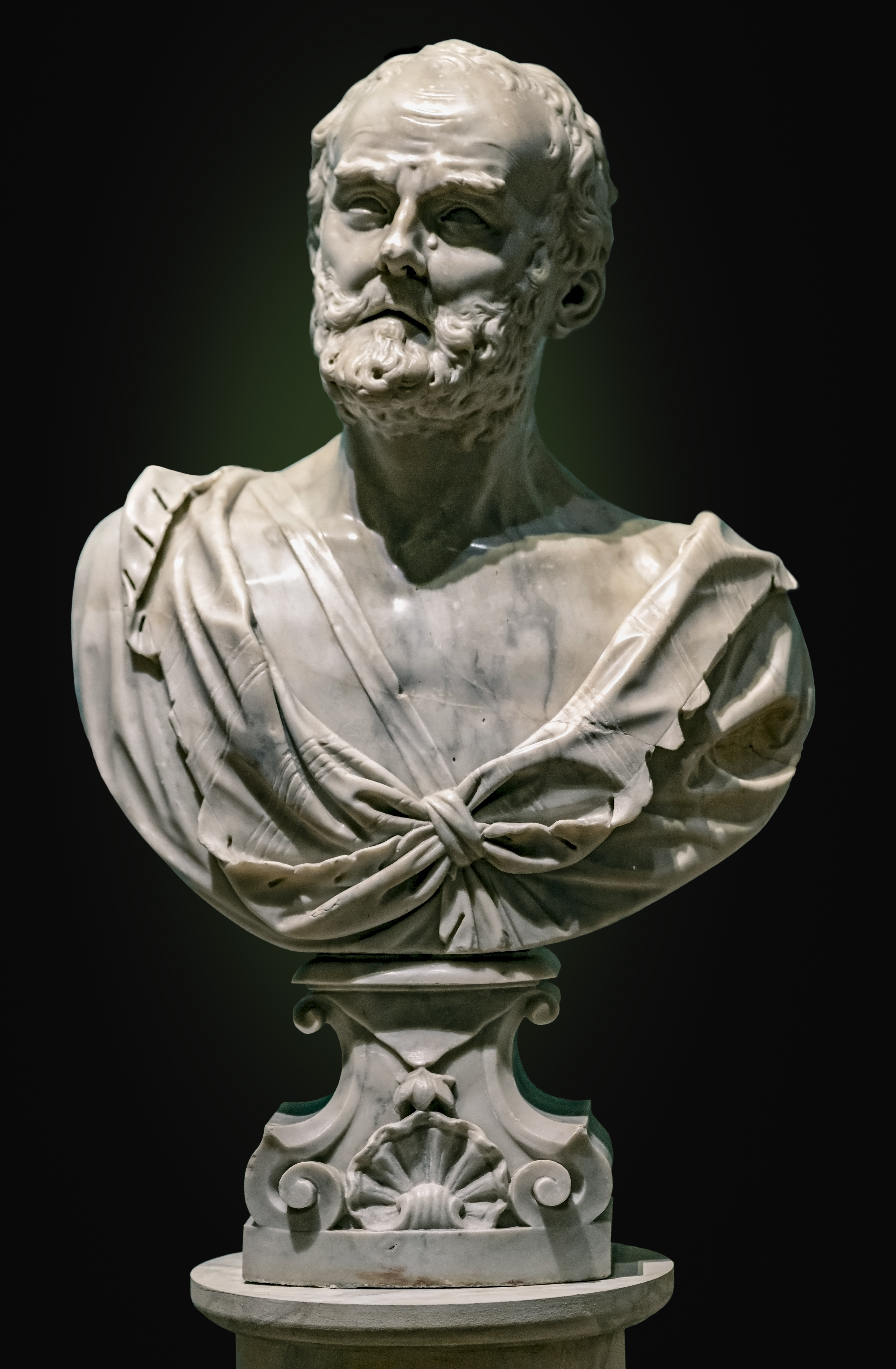
Heraklit Berühmte Zitate

„Augen sind genauere Zeugen als die Ohren.“
Fragmente, B 101a
Original altgriech.: "ὀφθαλμοὶ […] τῶν ὤτων ἀκριβέστεροι μάρτυρες."
„Der Krieg ist aller Dinge Vater.“
Fragmente, B 53
Original altgriech.: "πόλεμος πάντων μὲν πατήρ ἐστι."
Zitate über Menschen von Heraklit
„Allen Menschen ist es gegeben, sich selbst zu erkennen und klug zu sein.“
Fragmente, B 116
Original altgriech.: "ἀνθρώποισι πᾶσι μέτεστι γινώσκειν ἑωυτοὺς καὶ σωφρονεῖν."
Zitate über Seele von Heraklit
Fragmente, B 12
Original altgriech.: "ποταμοῖσι τοῖσιν αὐτοῖσιν ἐμβαίνουσιν ἕτερα καὶ ἕτερα ὕδατα ἐπιρρεῖ· καὶ ψυχαὶ δὲ ἀπὸ τῶν ὑγρῶν ἀναθυμιῶνται."
Heraklit Zitate und Sprüche

„Die schönste Harmonie entsteht durch Zusammenbringen der Gegensätze.“
Fragmente, B 8
Original altgriech.: "τὸ ἀντίξουν συμφέρον καὶ ἐκ τῶν διαφερόντων καλλίστην ἁρμονίαν […] γίνεσθαι."
„Für das Gesetz soll ein Volk kämpfen wie für seine Mauer.“
Fragmente, B 44
Original altgriech.: "μάχεσθαι χρὴ τὸν δῆμον ὑπὲρ τοῦ νόμου ὅκωσπερ τείχεος."
„Das Lernen vieler Dinge lehrt nicht Verständnis.“
Fragmente, B 40
(alternativ: "Viel Wissen bedeutet noch nicht Verstand.")
Original altgriech.: "πολυμαθίη νόον οὐ διδάσκει."
Fragmente, B 30
Original altgriech.: "κόσμον τόνδε, τὸν αὐτὸν ἁπάντων […] ἦν ἀεὶ καὶ ἔστιν καὶ ἔσται πῦρ ἀείζωον ἁπτόμενον μέτρα καὶ ἀποσβεννύμενον μέτρα."
„Die Natur liebt es, sich zu verbergen.“
Fragmente, B 123
Original altgriech.: "φύσις κρύπτεσθαι φιλεῖ."
Fragmente, B 51
Original altgriech.: "οὐ ξυνιᾶσιν ὅκως διαφερόμενον ἑωυτῶι συμφέρεται· παλίντονος ἁρμονίη ὅκωσπερ τόξου καὶ λύρη."

„Alles fließt, nichts bleibt.“
Vorsokratiker:58, mit Hinweis auf Aristoteles, Metaphysik i 6
Original altgriech.: "πάντα ῥεῖ, οὐδὲν μένει." Transkription "panta rhei, ouden menei."
Fälschlich zugeschrieben
Heraklit: Zitate auf Englisch
Fragment 92, as translated by G.W.T. Patrick, trans.
Numbered fragments
“The wise is one only. It is unwilling and willing to be called by the name of Zeus.”
Fragment 32
Numbered fragments
“The waking have one world in common; sleepers have each a private world of his own.”
Fragment 89
Plutarch, Of Superstition
Numbered fragments
“You cannot step twice into the same rivers.”
ποταμῷ γὰρ οὐκ ἔστιν ἐμβῆναι δὶς τῷ αὐτῷ
Fragment 91
Plutarch, On the EI at Delphi
Numbered fragments
Variante: You cannot step twice into the same rivers.
“Man, like a light in the night, is kindled and put out.”
Fragment 26
Numbered fragments
“Nature is wont to hide herself.”
Fragment 123
Numbered fragments
Fragment 30
Variant translations:
The world, an entity out of everything, was created by neither gods nor men, but was, is and will be eternally living fire, regularly becoming ignited and regularly becoming extinguished.
This world . . . ever was, and is, and shall be, ever-living Fire, in measures being kindled and in measure going out.
That which always was,
and is, and will be everlasting fire,
the same for all, the cosmos,
made neither by god nor man,
replenishes in measure
as it burns away.
Translated by Brooks Haxton
Numbered fragments
“Greater fates gain greater rewards”
As quoted by The Fragments of the Work of Heraclitus of Ephesus on Nature; Translated from the Greek Text of Bywater, with an Introduction Historical and Critical, by G. T. W. Patrick. Page 108 https://books.google.com/books?id=gLxQZb3TMYgC&lpg=PA108&ots=RUCu2BIyRB&dq=Greater%20fates%20gain%20greater%20rewards.&pg=PA108#v=onepage&q=Greater%20fates%20gain%20greater%20rewards.&f=false <br class="br">Alternative translation: Big results require big ambitions.
“Everything changes and nothing stands still.”
As quoted by Plato in Cratylus, 402a
Variants and variant translations:
Everything flows and nothing stays.
Everything flows and nothing abides.
Everything gives way and nothing stays fixed.
Everything flows; nothing remains.
All is flux, nothing is stationary.
All is flux, nothing stays still.
All flows, nothing stays.
Πάντα ῥεῖ
Everything flows.
This statement occurs in Simplicius' Commentary on Aristotle's Physics, 1313.11; while some sources attribute to Simplicius the coining of the specific phrase "πάντα ῥεῖ (panta rhei)", meaning "everything flows/is in a state of flux", to characterize the concept in the philosophy of Heraclitus, the essential phrasing "everything changes" and variations on it, in contexts where Heraclitus's thought is being alluded to, was current in both Plato and Aristotle's writings.
“It is harder to fight against pleasure than against anger.”
As quoted by Aristotle in Nicomachean Ethics, Book II (1105a)
Fragment 10
Variant translation: From out of all the many particulars comes oneness, and out of oneness come all the many particulars.
Numbered fragments
“It would not be better if things happened to people just as they wish.”
Fragment 110
Variant translation: It would not be better if things happened to men just as they wish.
Numbered fragments
“The many are mean; only the few are noble.”
in Eric Hoffer, Between the Devil and the Dragon (New York: 1982), p. 108
“He who does not expect will not find out the unexpected, for it is trackless and unexplored.”
Fragment 18, as quoted in The Art and Thought of Heraclitus: An Edition of the Fragments (1981) edited by Charles H. Kahn, p. 105
Variants:
He who does not expect the unexpected will not find it out.
The Art and Thought of Heraclitus: An Edition of the Fragments (1981) edited by Charles H. Kahn, p. 129
He who does not expect the unexpected will not find it, since it is trackless and unexplored.
As quoted in Helen by Euripides, edited by William Allan (2008), p. 278
Unless you expect the unexpected, you will not find it, for it is hidden and thickly tangled.
Rendering ἐὰν μή "unless" is more English-friendly without being inaccurate. As for the last clause, the point is that you can neither find it nor navigate your way through it. The alpha-privatives suggest using similar metaphoric adjectives to keep the Greek 'feel.' (S. N. Jenks, 2014)
Numbered fragments
“It is better to conceal ignorance than to expose it.”
Fragment 109
Variant translation: Hide our ignorance as we will, an evening of wine soon reveals it.
Numbered fragments
“Men that love wisdom must be acquainted with very many things indeed.”
As quoted Clement of Alexandria, Stromata, V, 140, 6 (Fragment 35)
Disputed
“Opposition brings concord. Out of discord comes the fairest harmony.”
As translated by Philip Wheelwright in Heraclitus (1959) https://archive.org/details/heraclitus00whee <br class="br">Disputed
“Change he called a pathway up and down, and this determines the birth of the world.”
From Lives and Opinions of Eminent Philosophers by Diogenes Laërtius, Book IX, section 8
G.T.W. Patrick, 1889 http://www.classicpersuasion.org/pw/heraclitus/herpatu.htm <br class="br">Variante: For what sense or understanding have they? They follow minstrels and take the multitude for a teacher, not knowing that many are bad and few good. For the best men choose one thing above all – immortal glory among mortals; but the masses stuff themselves like cattle.
“Though wisdom is common, yet the many live as if they had a wisdom of their own.”
Fragment 2, as quoted in Against the Mathematicians by Sextus Empiricus
Variant translation: So we must follow the common, yet the many live as if they had a wisdom of their own.
Numbered fragments
“It is wise to listen, not to me but to the Word, and to confess that all things are one.”
Fragment 50, as translated in the Loeb Classics edition http://www.loebclassics.com/view/heracleitus_philospher-universe/1931/pb_LCL150.471.xml?rskey=IyhfrN&result=8 <br class="br">Variant translations:<br>Listening not to me but to reason, it is wise to agree that all is one.<br>Listening not to me but to the Word it is wise to agree that all things are one.<br>He who hears not me but the logos will say: All is one.<br>It is wise to hearken, not to me, but to my Word, and to confess that all things are one. <br class="br">The word translated in these quotes and many others as "The Word" or "Reason", is the greek word λόγος (Logos). <br class="br">Numbered fragments
“Much learning does not teach understanding.”
Fragment 40
Numbered fragments
“Eternity is a child playing, playing checkers; the kingdom belongs to a child.”
Quoted by Hippolytus, Refutation of all heresies, IX, 9, 4 (Fragment 52), as translated in Reality (1994), by Carl Avren Levenson and Jonathan Westphal, p. 10
Variants:
History is a child building a sand-castle by the sea, and that child is the whole majesty of man’s power in the world.
As quoted in Contemporary Literature in Translation (1976), p. 21
A lifetime is a child playing, playing checkers; the kingdom belongs to a child.
As quoted in The Beginning of All Wisdom: Timeless Advice from the Ancient Greeks (2003) by Steven Stavropoulos, p. 95
Time is a game played beautifully by children.
As quoted in Fragments (2001) translated by Brooks Haxton
Lifetime is a child at play, moving pieces in a game. Kingship belongs to the child.
As quoted in The Art and Thought of Heraclitus (1979) translated by Charles H. Kahn
Fragment 93
Friedrich Nietzsche's translation: The law under which most of them ceaselessly have commerce they reject for themselves. (The Pre-Platonic Philosophers, Chapter 10)]
Numbered fragments
G. T. W. Patrick, 1889 http://www.classicpersuasion.org/pw/heraclitus/herpatu.htm
“The people must fight for its law as for its walls.”
Fragment 44
Numbered fragments
“Dogs, also, bark at what they do not know.”
Fragment 97
Numbered fragments


