„Alles, was wir mit Wärme und Enthusiasmus ergreifen, ist eine Art der Liebe.“
Ideen über Staatsverfassung
Ideen über Staatsverfassung
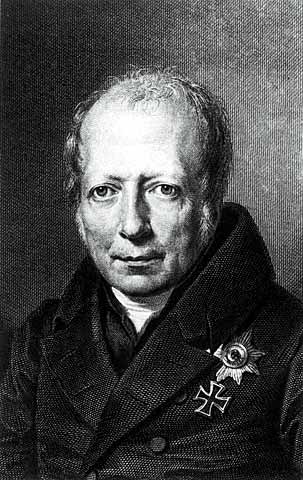
Friedrich Wilhelm Christian Carl Ferdinand von Humboldt war ein preußischer Gelehrter, Schriftsteller und Staatsmann. Als Bildungsreformer initiierte er die Neuorganisation des Bildungswesens im Geiste des Neuhumanismus und betrieb die Gründung der Friedrich-Wilhelms-Universität Berlin.
Er zählt zu den großen, fortwirkend einflussreichen Persönlichkeiten in der deutschen Kulturgeschichte. Betrachtet man ihn in der Gemeinschaft mit seinem Bruder Alexander von Humboldt, so wird man kaum ein zweites Geschwisterpaar finden, das die eigene geschichtliche Epoche mit solchem Forscherdrang und mit solch universeller Gelehrsamkeit geprägt hat wie diese beiden. Während Alexander dabei vor allem – aber keineswegs nur – der naturwissenschaftlichen Forschung neue Horizonte erschlossen hat, lagen die Schwerpunkte für Wilhelm in der Beschäftigung mit kulturwissenschaftlichen Zusammenhängen wie der Bildungsproblematik, der Staatstheorie, der analytischen Betrachtung von Sprache, Literatur und Kunst sowie in aktiver politischer Mitgestaltung als Reformmotor im Schul- und Universitätswesen und als preußischer Diplomat.
„Alles, was wir mit Wärme und Enthusiasmus ergreifen, ist eine Art der Liebe.“
Ideen über Staatsverfassung
Ideen über Staatsverfassung
Briefe an eine Freundin
Briefe an eine Freundin
„Denn wem sich der Mensch widmet, zu dem gelangt er nach dem Tode.“
S.22. VIII.13. IX.25. XVI.19. <br class="br">Über die unter dem Namen Bhagavad-Gita bekannte Episode des Maha-Bharata ( S. 39 books.google http://books.google.de/books?id=_ClHAQAAIAAJ&pg=RA2-PA39&dq=widmet) <br class="br">Bhagavad-Gitá
„Das Arbeiten ist meinem Gefühl nach dem Menschen so gut ein Bedürfnis wie Essen und Schlafen.“
Briefe an eine Freundin
Briefe an eine Freundin
„Es ist unglaublich, wie viel Kraft die Seele dem Körper zu leihen vermag.“
Briefe an eine Freundin
Briefe an eine Freundin
Briefe an eine Freundin, 21. Brief: Tegel, den 4. December 1830. 5. Auflage, 2. Theil. Leipzig: Brockhaus, 1853. S. 103 f.
Briefe an eine Freundin
Variante: Ich finde... dass sich ein Buch gerade vorzugsweise zu einem freundschaftlichen Geschenk eignet, man liest es oft, man kehrt oft dazu zurück, man naht sich ihm aber nur in ausgewählten Momenten, braucht es nicht wie eine Tasse, ein Glas, einen Hausrat in jedem gleichgültigen Augenblick des Lebens und erinnert sich so immer des Freundes im Augenblick eines würdigen Genusses.
Briefe an eine Freundin, Burgörner, den 6. September 1825. Projekt Gutenberg http://www.gutenberg.org/files/21801/21801-h/21801-h.htm <br class="br">Briefe an eine Freundin
Briefe an eine Freundin. Erster Theil. Leipzig 1847. 41. Brief: Berlin, den 8. März 1825, S. 155 books.google http://books.google.de/books?id=rX8EAAAAQAAJ&pg=PA155&dq=Vorrecht <br class="br">Briefe an eine Freundin
Ideen über Staatsverfassung
Ideen über Staatsverfassung
Letzte Worte, als er in den Armen seines Bruders starb
Letzte Worte
As quoted in The Linguistic Relativity Principle and Humboldtian Ethnolinguistics : A History And Appraisal (1963) by Robert Lee Miller, and The Linguistic Turn in Hermeneutic Philosophy (2002) by Cristina Lafont
Kontext: The interdependence of word and idea shows clearly that languages are not actually means of representing a truth already known, but rather of discovering the previously unknown. Their diversity is not one of sounds and signs, but a diversity of world perspectives [Weltansichten]. … The sum of the knowable, as the field to be tilled by the human mind, lies among all languages, independent of them, in the middle. Man cannot approach this purely objective realm other than through his cognitive and sensory powers, that is, in a subjective manner.
“How a person masters his fate is more important than what his fate is.”
As quoted in International Proverbs (2000) by Luzano Pancho Canlas, p. 40
The Limits of State Action (1792)
Kontext: Owing to the vigorous and elastic strength of man’s original power, necessity does not often require anything save the removal of oppressive bonds. From all these reasons (to which a more detailed analysis of the subject might add many more) it will be seen, that there is no other principle than this so perfectly accordant with the reverence we owe to the individuality of spontaneous beings, and with the solicitude for freedom which that reverence inspires. Finally, the only infallible means of securing power and authority to laws, is to see that they originate in this principle alone.
Quelle: The Limits of State Action (1792), Ch. 6
Kontext: The grand, leading principle, towards which every argument hitherto unfolded in these pages directly converges, is the absolute and essential importance of human development in its richest diversity; but national education, since at least it presupposes the selection and appointment of some one instructor, must always promote a definite form of development, however careful to avoid such an error. And hence it is attended with all those disadvantages which we before observed to flow from such a positive policy; and it only remains to be added, that every restriction becomes more directly fatal, when it operates on the moral part of our nature,—that if there is one thing more than another which absolutely requires free activity on the part of the individual, it is precisely education, whose object it is to develop the individual.
“Man is naturally more disposed to beneficent than selfish actions.”
Quelle: The Limits of State Action (1792), Ch. 8
Kontext: Man is naturally more disposed to beneficent than selfish actions. This we learn even from the history of savages. The domestic virtues have something in them so inviting and genial, and the public virtues of the citizen something so grand and inspiring, that even he who is barely uncorrupted, is seldom able to resist their charm.
“It is only through extremes that men can arrive at the middle path of wisdom and virtue.”
Quelle: The Limits of State Action (1792), Ch. 8
Kontext: Setting aside the fact that coercion and guidance can never succeed in producing virtue, they manifestly tend to weaken power; and what are tranquil order and outward morality without true moral strength and virtue? Moreover, however great an evil immorality may be, we must not forget that it is not without its beneficial consequences. It is only through extremes that men can arrive at the middle path of wisdom and virtue.
Kosmos (1847)
Kontext: If we would indicate an idea which, throughout the whole course of history, has ever more and more widely extended its empire, or which, more than any other, testifies to the much-contested and still more decidedly misunderstood perfectibility of the whole human race, it is that of establishing our common humanity — of striving to remove the barriers which prejudice and limited views of every kind have erected among men, and to treat all mankind, without reference to religion, nation, or color, as one fraternity, one great community, fitted for the attainment of one object, the unrestrained development of the physical powers. This is the ultimate and highest aim of society, identical with the direction implanted by nature in the mind of man toward the indefinite extension of his existence. He regards the earth in all its limits, and the heavens as far as his eye can scan their bright and starry depths, as inwardly his own, given to him as the objects of his contemplation, and as a field for the development of his energies. Even the child longs to pass the hills or the seas which inclose his narrow home; yet, when his eager steps have borne him beyond those limits, he pines, like the plant, for his native soil; and it is by this touching and beautiful attribute of man — this longing for that which is unknown, and this fond remembrance of that which is lost — that he is spared from an exclusive attachment to the present. Thus deeply rooted in the innermost nature of man, and even enjoined upon him by his highest tendencies, the recognition of the bond of humanity becomes one of the noblest leading principles in the history of mankind.
As quoted in Wilhelm von Humboldt (1970), by P. Berglar, p. 87, and "Profiles of Educators: Wilhelm von Humboldt (1767–1835)" by Karl-Heinz Günther, in Prospects, Vol. 18, Issue 1 (March 1988)
Kontext: There are undeniably certain kinds of knowledge that must be of a general nature and, more importantly, a certain cultivation of the mind and character that nobody can afford to be without. People obviously cannot be good craftworkers, merchants, soldiers or businessmen unless, regardless of their occupation, they are good, upstanding and – according to their condition – well-informed human beings and citizens. If this basis is laid through schooling, vocational skills are easily acquired later on, and a person is always free to move from one occupation to another, as so often happens in life.
Quelle: The Limits of State Action (1792), Ch. 16
Kontext: The incapacity for freedom can only arise from a want of moral and intellectual power; to elevate this power is the only way to counteract this want; but to do this presupposes the exercise of that power, and this exercise presupposes the freedom which awakens spontaneous activity. Only it is clear we cannot call it giving freedom, when fetters are unloosed which are not felt as such by him who wears them. But of no man on earth—however neglected by nature, and however degraded by circumstances—is this true of all the bonds which oppress and enthral him. Let us undo them one by one, as the feeling of freedom awakens in men’s hearts, and we shall hasten progress at every step. There may still be great difficulties in being able to recognize the symptoms of this awakening. But these do not lie in the theory so much as in its execution, which, it is evident, never admits of special rules, but in this case, as in every other, is the work of genius alone.
“To inquire and to create;—these are the grand centres around which all human pursuits revolve,”
Quelle: The Limits of State Action (1792), Ch. 8
Kontext: To inquire and to create;—these are the grand centres around which all human pursuits revolve, or at least to these objects do they all more or less directly refer.
Quelle: The Limits of State Action (1792), Ch. 16
Quelle: The Limits of State Action (1792), Ch. 8
Quelle: The Limits of State Action (1792), Ch. 1
The Limits of State Action (1792)
Kosmos (1847)
Quelle: The Limits of State Action (1792), Ch. 2
Quelle: The Limits of State Action (1792), Ch. 8
Quelle: The Limits of State Action (1792), Ch. 16
Quelle: The Limits of State Action (1792), Ch. 8
Quelle: The Limits of State Action (1792), Ch. 8
Quelle: The Limits of State Action (1792), Ch. 16
The Limits of State Action (1792)
As quoted in The Liberal Tradition in European Thought (1971) by David Sidorsky, p. 73
“True enjoyment comes from activity of the mind and exercise of the body; the two are ever united.”
As quoted in A Dictionary of Thoughts : Being a Cyclopedia of Laconic Quotations from the Best Authors of the World, both Ancient and Modern (1908) edited by Tryon Edwards
“That government is best which makes itself unnecessary.”
Diejenige Regierung ist die beste, die sich überflüssing macht.
As quoted in Dictionary of Quotations from Ancient and Modern English and Foreign Sources (1899) by James Wood
Quelle: The Limits of State Action (1792), Ch. 7


