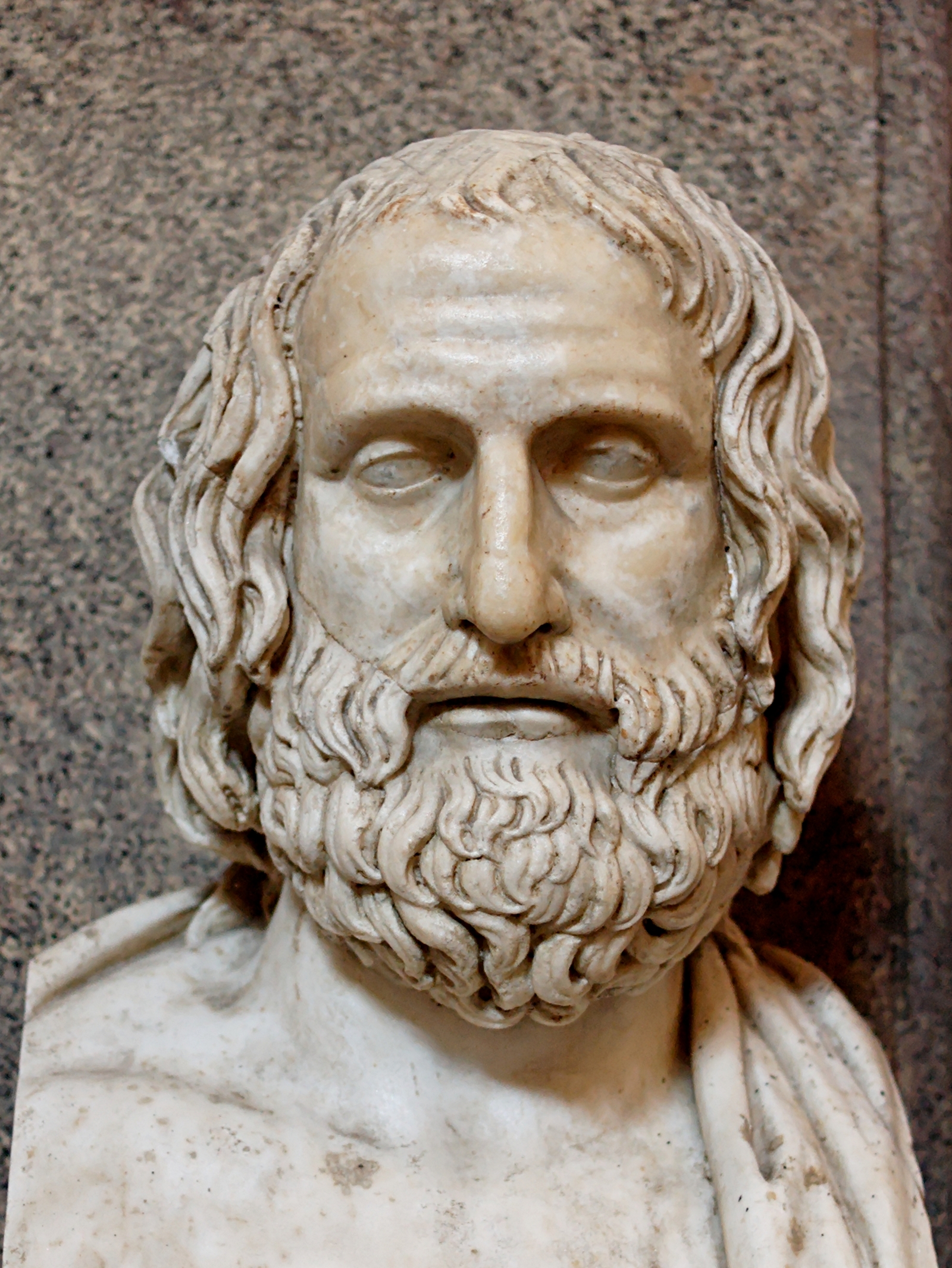
Euripidés Berühmte Zitate

Euripidés Zitate und Sprüche
„Abwechslung in allem ist süß.“
Orest 234 / Elektra
Original altgriech.: "μεταβολὴ πάντων γλυκύ."
„Die Zeit entlarvt den Bösen.“
Hippolyt 428 / Phädra
Original altgriech.: "Κακοὺς δὲ θνητῶν ἐξέφην' ὅταν τύχῃ."
„Du zählst im Elend keinen Freund.“
Elektra 1131 / Elektra
Original altgriech.: "πένητας οὐδεὶς βούλεται κτᾶσθαι φίλους."
„Ein guter Mann wird stets das Bessre wählen.“
Iphigenie in Aulis, 502f / Menelaus
Original altgriech.: "ἀνδρὸς οὐ κακοῦ τρόποι // τοιοίδε, χρῆσθαι τοῖσι βελτίστοις ἀεί.."
„Ein vorsichtiger ist besser als ein waghalsiger Heerführer.“
Die Phönizierinnen 599 / Polyneikes
Original altgriech.: "ἀσφαλὴς γάρ ἐστ' ἀμείνων ἢ θρασὺς στρατηλάτης."
„Ob einem reiche Totengabe wird zuteil, das ist nur eitle Prahlerei der Lebenden.“
Die Troerinnen 1249f / Hekuba
Original altgriech.: "εἰ πλουσίων τις τεύξεται κτερισμάτων· // κενὸν δὲ γαύρωμ´ ἐστὶ τῶν ζώντων τόδε."
„Sei bei mir, in Maßen zwar, doch verlasse mich nicht.“
über den Wein, gemäß Plutarch Moralia, Vorschriften zur Gesundheit, Kapitel 19
Original altgriech.: "εἴης μοι, μέτριος δέ πως // εἴης μηδ´ ἀπολείποις."
Euripidés: Zitate auf Englisch
“Those whom the gods wish to destroy they first make mad.”
Anonymous ancient proverb, wrongly attributed to Euripides. The version here is quoted as a "heathen proverb" in Daniel, a Model for Young Men (1854) by William Anderson Scott. The origin of the misattribution to Euripides is unknown. Several variants are quoted in ancient texts, as follows. <br class="br">Variants and derived paraphrases: <br class="br">For cunningly of old<br>was the celebrated saying revealed:<br>evil sometimes seems good<br>to a man whose mind<br>a god leads to destruction. <br class="br">Sophocles, Antigone 620-3, a play pre-dating any of Euripides' surviving plays. An ancient commentary explains the passage as a paraphrase of the following, from another, earlier poet. <br class="br">When a god plans harm against a man,<br>he first damages the mind of the man he is plotting against. <br class="br">Quoted in the scholia vetera to Sophocles' Antigone 620ff., without attribution. The meter (iambic trimeter) suggests that the source of the quotation is a tragic play. <br class="br">For whenever the anger of divine spirits harms someone,<br>it first does this: it steals away his mind<br>and good sense, and turns his thought to foolishness,<br>so that he should know nothing of his mistakes. <br class="br">Attributed to "some of the old poets" by Lycurgus of Athens in his Oratio In Leocratem [Oration Against Leocrates], section 92. Again, the meter suggests that the source is a tragic play. These lines are misattributed to the much earlier semi-mythical statesman Lycurgus of Sparta in a footnote of recent editions of Bartlett's Familiar Quotations and other works. <br class="br">The gods do nothing until they have blinded the minds of the wicked. <br class="br">Variant in 'Dictionary of Quotations (Classical) (1906), compiled by Thomas Benfield Harbottle, p. 433. <br class="br">Whom Fortune wishes to destroy she first makes mad. <br class="br">Publilius Syrus, Maxim 911 <br class="br">The devil when he purports any evil against man, first perverts his mind. <br class="br">As quoted by Athenagoras of Athens [citation needed] <br class="br">quem Iuppiter vult perdere, dementat prius. <br class="br">"Whom Jupiter wishes to destroy, he first sends mad"; neo-Latin version. Similar wording is found in James Duport's Homeri Gnomologia (1660), p. 234. "A maxim of obscure origin which may have been invented in Cambridge about 1640" -- Taylor, The Proverb (1931). Probably a variant of the line "He whom the gods love dies young", derived from Menander's play The Double Deceiver via Plautus (Bacchides 816-7). <br class="br">quem (or quos) Deus perdere vult, dementat prius. <br class="br">Whom God wishes to destroy, he first sends mad. <br class="br">Whom the gods would destroy, they first make mad. <br class="br">This variant is spoken by Prometheus, in The Masque of Pandora (1875) by Henry Wadsworth Longfellow <br class="br">Those whom the gods would destroy, they first make mad. <br class="br">As quoted in George Fox Interpreted: The Religion, Revelations, Motives and Mission of George Fox (1881) by Thomas Ellwood Longshore, p. 154 <br class="br">Those whom God wishes to destroy, he first makes mad. <br class="br">As quoted in Bartlett's Familiar Quotations 16th edition (1992) <br class="br">Nor do the gods appear in warrior's armour clad<br>To strike them down with sword and spear<br>Those whom they would destroy<br>They first make mad. <br class="br">Bhartṛhari, 7th c. AD; as quoted in John Brough,Poems from the Sanskrit, (1968), p, 67 <br class="br">vināśakāle viparītabuddhiḥ <br class="br">Sanskrit Saying (also in Jatak katha): "When a man is to be destroyed, his intelligence becomes self-destructive." <br class="br">Modern derivatives:<br>The proverb's meaning is changed in many English versions from the 20th and 21st centuries that start with the proverb's first half (through "they") and then end with a phrase that replaces "first make mad" or "make mad." Such versions can be found at Internet search engines by using either of the two keyword phrases that are on Page 2 and Page 4 of the webpage " Pick any Wrong Card http://www.bu.edu/av/celop2/not_ESL/pick_any_wrong_card.pdf." The rest of that webpage is frameworks that induce a reader to compose new variations on this proverb. <br class="br">Misattributed
“Arm yourself, my heart: the thing that you must do is fearful, yet inevitable.”
Quelle: Medea and Other Plays: Medea / Alcestis / The Children of Heracles / Hippolytus
“Do not mistake the rule of force
for true power. Men are not shaped by force.”
Euripidés The Bacchae
Quelle: The Bacchae
“No one can confidently say that he will still be living tomorrow.”
Euripidés Alcestis
Quelle: Alcestis (438 BC), l. 783-4
“There is in the worst of fortune the best of chances for a happy change.”
Euripidés Iphigenia in Tauris
Iphigenia in Tauris (c. 412 BC) l. 721
“Authority is never without hate.”
Euripidés Ion
Ion (c. 421-408 BC) as translated by Ronald F. Willetts
“Silence is an answer in the eyes of the wise.”
Unidentified Plays, Fragment 977
Variant translation: Silence is true wisdom's best reply. (See Discussion page for sourcing information)
“In this world second thoughts, it seems, are best.”
Euripidés Hippolytus
Variant translations: Among mortals second thoughts are the wisest.
Second thoughts are ever wiser.
Among mortals second thoughts are wisest.
Quelle: Hippolytus (428 BC), l. 435, as translated by David Grene


