Thomas Stearns Eliot buch The Rock
Choruses from "The Rock", 1934, I
Original: (en) Where is the wisdom we have lost in knowledge? Where is the knowledge we have lost in information?
Thomas Stearns Eliot war ein englischsprachiger Lyriker, Dramatiker und Kritiker, der als einer der bedeutendsten Vertreter der literarischen Moderne gilt. Im Jahr 1948 wurde er mit dem Literaturnobelpreis ausgezeichnet.
Eliot studierte Philosophie und Literatur in Harvard. Nach einem Studienjahr an der Sorbonne und einem Aufenthalt 1914 an der Universität Marburg wanderte Eliot zu Beginn des Ersten Weltkriegs nach London aus und lebte fortan überwiegend dort. Er arbeitete zunächst als Lehrer, dann von 1917 bis 1925 in der Auslandsabteilung der Lloyds Bank bis zu seinem Eintritt in das Verlagshaus Faber und Faber, in dessen Leitung er über Jahrzehnte wirkte. In den 1920er Jahren verbrachte er viel Zeit in Paris. 1927 wurde er britischer Staatsbürger und trat der Church of England bei.Erste Erfolge als Literat feierte Eliot 1915 mit J. Alfred Prufrocks Liebesgesang ; doch der internationale Durchbruch glückte ihm erst 1922 mit Das wüste Land, einem der wirkungsgeschichtlich einflussreichsten Gedichte des 20. Jahrhunderts. Es wurde oft mit James Joyce’ Jahrhundertroman Ulysses verglichen, der im selben Jahr beim selben Verleger erstmals erschien. Es folgten Die hohlen Männer, Aschermittwoch und die Vier Quartette, die sein Spätwerk darstellen und dazu beitrugen, dass ihm 1948 der Nobelpreis für Literatur verliehen wurde.Eliot war ebenso als Dramatiker tätig und veröffentlichte sieben Dramen, von denen Mord im Dom das heute international bekannteste Werk ist. Als Die Cocktailparty 1950 auf dem Broadway aufgeführt wurde, erhielt Eliot als Autor des Stückes den Tony Award für das Beste Theaterstück.
Eliots spröde, beziehungsreiche Lyrik ist reich an Anspielungen auf Mythos, Kultur und Dichtung vom alten Indien über das Mittelalter bis zur Vorkriegszeit . Sie spiegelt eine aus den Fugen geratene Welt und versucht, das Existenzproblem des modernen Menschen durch Hinwendung zu einem christlich fundierten Humanismus zu lösen. Seine Bühnenwerke bilden die Wiederbelebung des poetischen Dramas. Wikipedia
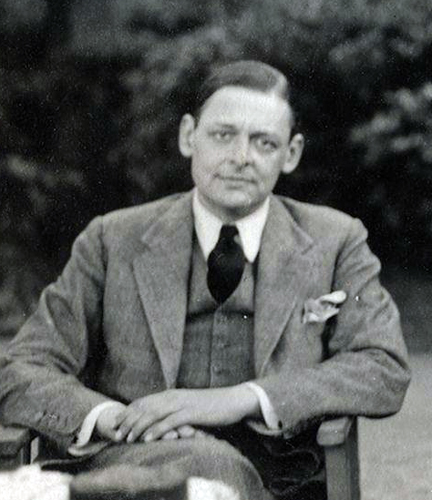
Thomas Stearns Eliot buch The Rock
Choruses from "The Rock", 1934, I
Original: (en) Where is the wisdom we have lost in knowledge? Where is the knowledge we have lost in information?
T.S. Eliot buch The Waste Land
Quelle: The Waste Land and Other Poems
T.S. Eliot buch The Waste Land
Quelle: The Waste Land (1922)
“For he will do
As he do do
And there's no doing anything about it!”
T.S. Eliot buch Old Possum's Book of Practical Cats
Quelle: Old Possum's Book of Practical Cats
T.S. Eliot buch The Waste Land
Quelle: The Waste Land and Other Poems
T.S. Eliot buch Four Quartets
Quelle: Four Quartets
Quelle: Christianity and Culture: The Idea of a Christian Society and Notes Towards the Definition of Culture
“Now that the lilacs are in bloom
She has a bowl of lilacs in her room”
Quelle: Collected Poems, 1909-1962
T.S. Eliot The Cocktail Party
Quelle: The Cocktail Party
Quelle: Tradition and the Individual Talent: An Essay
“Oh, do not ask, 'What is it?'/Let us go and make our visit.”
Quelle: The Love Song of J. Alfred Prufrock and Other Poems
T.S. Eliot buch Four Quartets
Variante: We must not cease from exploration. And the end of all our exploring will be to arrive where we began and to know the place for the first time.
Quelle: Four Quartets
T.S. Eliot buch Poems
"Whispers of Immortality"; "Grishkin" has been identified by Ezra Pound as having been "Serafima Astafieva" a Russian dancer.
Poems (1920)
T.S. Eliot buch Old Possum's Book of Practical Cats
The Naming of Cats
Old Possum's Book of Practical Cats (1939)
Notes towards the definition of culture(1948)
Introduction to Pascal’s Pensées
Ash-Wednesday (1930)
“The soul of Man must quicken to creation.”
Choruses from The Rock (1934)
T.S. Eliot buch The Waste Land
Quelle: The Waste Land (1922), Line 385 et seq.
T.S. Eliot buch The Waste Land
Quelle: The Waste Land (1922), Line 320 et seq.
“Our age is an age of moderate virtue
And moderate vice”
Choruses from The Rock (1934)
T.S. Eliot buch Poems
"The Hippopotamus"
Poems (1920)
“O Light Invisible, we praise Thee!
Too bright for mortal vision.”
Choruses from The Rock (1934)


