Thomas Stearns Eliot buch The Rock
Choruses from "The Rock", 1934, I
Original: (en) Where is the wisdom we have lost in knowledge? Where is the knowledge we have lost in information?
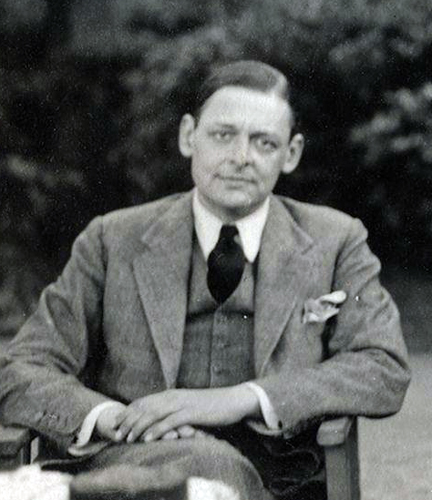
Thomas Stearns Eliot war ein englischsprachiger Lyriker, Dramatiker und Kritiker, der als einer der bedeutendsten Vertreter der literarischen Moderne gilt. Im Jahr 1948 wurde er mit dem Literaturnobelpreis ausgezeichnet.
Eliot studierte Philosophie und Literatur in Harvard. Nach einem Studienjahr an der Sorbonne und einem Aufenthalt 1914 an der Universität Marburg wanderte Eliot zu Beginn des Ersten Weltkriegs nach London aus und lebte fortan überwiegend dort. Er arbeitete zunächst als Lehrer, dann von 1917 bis 1925 in der Auslandsabteilung der Lloyds Bank bis zu seinem Eintritt in das Verlagshaus Faber und Faber, in dessen Leitung er über Jahrzehnte wirkte. In den 1920er Jahren verbrachte er viel Zeit in Paris. 1927 wurde er britischer Staatsbürger und trat der Church of England bei.Erste Erfolge als Literat feierte Eliot 1915 mit J. Alfred Prufrocks Liebesgesang ; doch der internationale Durchbruch glückte ihm erst 1922 mit Das wüste Land, einem der wirkungsgeschichtlich einflussreichsten Gedichte des 20. Jahrhunderts. Es wurde oft mit James Joyce’ Jahrhundertroman Ulysses verglichen, der im selben Jahr beim selben Verleger erstmals erschien. Es folgten Die hohlen Männer, Aschermittwoch und die Vier Quartette, die sein Spätwerk darstellen und dazu beitrugen, dass ihm 1948 der Nobelpreis für Literatur verliehen wurde.Eliot war ebenso als Dramatiker tätig und veröffentlichte sieben Dramen, von denen Mord im Dom das heute international bekannteste Werk ist. Als Die Cocktailparty 1950 auf dem Broadway aufgeführt wurde, erhielt Eliot als Autor des Stückes den Tony Award für das Beste Theaterstück.
Eliots spröde, beziehungsreiche Lyrik ist reich an Anspielungen auf Mythos, Kultur und Dichtung vom alten Indien über das Mittelalter bis zur Vorkriegszeit . Sie spiegelt eine aus den Fugen geratene Welt und versucht, das Existenzproblem des modernen Menschen durch Hinwendung zu einem christlich fundierten Humanismus zu lösen. Seine Bühnenwerke bilden die Wiederbelebung des poetischen Dramas. Wikipedia
Thomas Stearns Eliot buch The Rock
Choruses from "The Rock", 1934, I
Original: (en) Where is the wisdom we have lost in knowledge? Where is the knowledge we have lost in information?
T.S. Eliot buch The Hollow Men
The Hollow Men (1925)
T.S. Eliot buch Old Possum's Book of Practical Cats
Gus: The Theatre Cat
Old Possum's Book of Practical Cats (1939)
T.S. Eliot buch Tradition and the Individual Talent
Tradition and the Individual Talent (1919)
“In the room the women come and go
Talking of Michelangelo.”
T.S. Eliot The Love Song of J. Alfred Prufrock
The Love Song of J. Alfred Prufrock (1915)
T.S. Eliot buch The Waste Land
Quelle: The Waste Land (1922), Line 60 et seq.
This is a reference to Dante's Inferno, Canto III, lines 55-57
“When the day's hustle and bustle is done,
Then the Gumbie Cat's work is but hardly begun.”
T.S. Eliot buch Old Possum's Book of Practical Cats
The Old Gumbie Cat
Old Possum's Book of Practical Cats (1939)
“Much to cast down, much to build, much to restore.”
Choruses from The Rock (1934)
“Weave the wind. I have no ghosts,
An old man in a draughty house
Under a windy knob.”
T.S. Eliot buch Poems
"Gerontion"
Poems (1920)
T.S. Eliot buch The Waste Land
Quelle: The Waste Land (1922), Line 367 et seq.
Choruses from The Rock (1934)
The Music of Poetry (24 February 1942) the third W. P. Ker memorial lecture delivered in the University of Glasgow
“Let me show you the work of the humble. Listen.”
Choruses from The Rock (1934)
T.S. Eliot buch Old Possum's Book of Practical Cats
Macavity: The Mystery Cat
Old Possum's Book of Practical Cats (1939)
“O O O O that Shakespeherian Rag—
It's so elegant
So intelligent”
T.S. Eliot buch The Waste Land
Quelle: The Waste Land (1922), Line 128 et seq.
T.S. Eliot buch Tradition and the Individual Talent
Tradition and the Individual Talent (1919)
“A dangerous person to disagree with.”
On Samuel Johnson in Homage to John Dryden: Three Essays on Poetry of the Seventeenth Century (1927)
T.S. Eliot buch Old Possum's Book of Practical Cats
Macavity: The Mystery Cat
Old Possum's Book of Practical Cats (1939)
Ash-Wednesday (1930)
Kontext: And the lost heart stiffens and rejoices
In the lost lilac and the lost sea voices
And the weak spirit quickens to rebel
For the bent golden-rod and the lost sea smell
Quickens to recover
The cry of quail and the whirling plover
And the blind eye creates
The empty forms between the ivory gates
And smell renews the salt savour of the sandy earth
This is the time of tension between dying and birth
The place of solitude where three dreams cross
Between blue rocks
But when the voices shaken from the yew-tree drift away
Let the other yew be shaken and reply.
T.S. Eliot buch Tradition and the Individual Talent
Tradition and the Individual Talent (1919)
T.S. Eliot buch Old Possum's Book of Practical Cats
Macavity: The Mystery Cat
Old Possum's Book of Practical Cats (1939)
T.S. Eliot buch Poems
"Burbank with a Baedeker: Bleistein with a cigar"
Poems (1920)


