„Freude wird jedes Mal dein Abendbrot sein, wenn du den Tag nützlich zugebracht hast.“
Nachfolge Christi 1, 25, 11
Original lat.: "Gaudebis semper de vespere, si diem expendes fructuose."
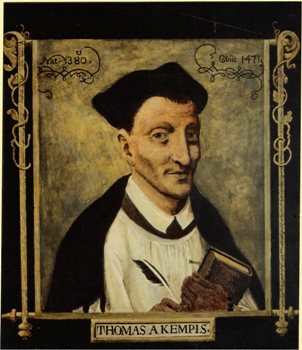
Thomas von Kempen, lat. Thomas a Kempis , war ein Augustiner-Chorherr, Mystiker und geistlicher Schriftsteller des 15. Jahrhunderts. Wikipedia
„Freude wird jedes Mal dein Abendbrot sein, wenn du den Tag nützlich zugebracht hast.“
Nachfolge Christi 1, 25, 11
Original lat.: "Gaudebis semper de vespere, si diem expendes fructuose."
Nachfolge Christi 2, 2, 1
Original lat.: "Non magni pendas qui pro te vel contra te fit, sed hoc age, et cura, ut Deus tecum sit in omni re quam facis."
Nachfolge Christi 3, 15, 2
Original lat.: "Domine, tu scis qualiter melius est (mihi): fac hoc vel illud sicut volueris. Da mihi quod vis et quantum vis et quando vis. […] Pone me ubi vis et liber age mecum in omnibus."
„Denke immer an das Ende, da die verlorene Zeit nicht zurückkehrt“
Thomas von Kempen buch Nachfolge Christi
De imitatione Christi (deutsch: Nachfolge Christi), um 1420, 1,25,43
Original lat.: "Memento semper finis, et quia perditum non redit tempus."
Nachfolge Christi 1, 16, 2
Original lat.: "Stude patiens esse in tolerando aliorum defectus, et qualescumque infirmitates, quia et tu multa habes, quæ ab aliis oportet tolerari."
„Was der Zeit unterworfen ist, das brauche; was ewig ist, danach strebe.“
Nachfolge Christi 3, 16, 1
Original lat.: "Sint temporalia in usu, æterna in desiderio."
„Wer etwas Eigenes haben will, verliert das Gemeinsame.“
Nachfolge Christi 3, 13, 1
Original lat.: "Qui quærit habere privata, amittit communia."
Quelle: Dictionary of Burning Words of Brilliant Writers (1895), P. 578.
Quelle: Dictionary of Burning Words of Brilliant Writers (1895), P. 124.
“How fast passes away the glory of this world.”
O quam cito transit gloria mundi.
Thomas à Kempis buch Nachfolge Christi
Book I, ch. 3.
These words are used in the crowning of the pope.
The Imitation of Christ (c. 1418)
“And when he is out of sight, quickly also is he out of mind.”
Thomas à Kempis buch Nachfolge Christi
Book I, ch. 23.
The Imitation of Christ (c. 1418)
“There is no creature so small and abject, that it representeth not the goodness of God.”
Quelle: Dictionary of Burning Words of Brilliant Writers (1895), P. 261.
Quelle: Dictionary of Burning Words of Brilliant Writers (1895), P. 62.
Quelle: Dictionary of Burning Words of Brilliant Writers (1895), P. 365.
Thomas à Kempis buch Nachfolge Christi
Book I, ch. 20.
The Imitation of Christ (c. 1418)
Quelle: Dictionary of Burning Words of Brilliant Writers (1895), P. 293.
“Of two evils, the less is always to be chosen.”
Thomas à Kempis buch Nachfolge Christi
Book III. ch. 12.
The Imitation of Christ (c. 1418)
Quelle: Dictionary of Burning Words of Brilliant Writers (1895), P. 545.


