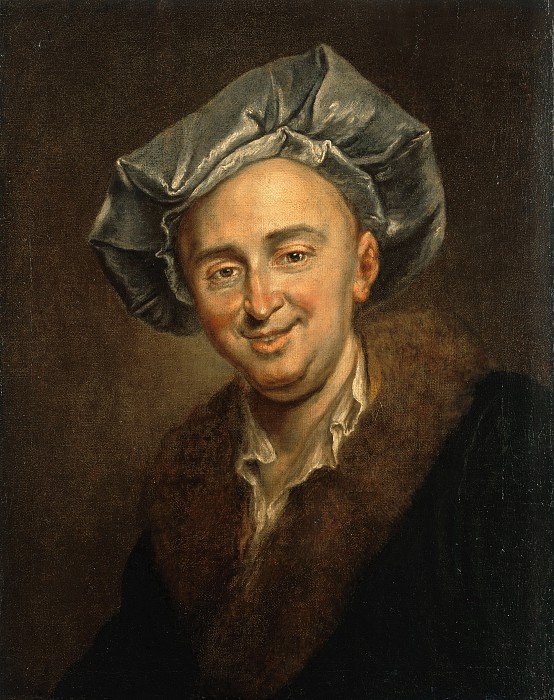
Julien Offray de La Mettrie Zitate

Julien Offray de La Mettrie war ein französischer Arzt und Philosoph. Bekanntheit erlangte er vor allem durch sein konsequent materialistisches Menschenbild, weswegen er seinen Zeitgenossen als enfant terrible der Aufklärung galt.

✵ 12. Dezember 1709 – 11. November 1751  •  Andere Namen Julien Offroy De La Mettrie
Julien Offray de La Mettrie Foto
Julien Offray de La Mettrie: 48 Zitate1 Gefällt mir

Julien Offray de La Mettrie Berühmte Zitate

„Trink, iss, schlafe schnarche, träume!“

Julien Offray de La Mettrie

Über das Glück oder Das Höchste Gut, »Anti-Seneca«, LSR-Quellen Band 2, herausgegeben und übersetzt von Bernd A. Laska, Nürnberg 1985/2002, S.112 [171]. (siehe Aufsatztitel: Michael Winter: Trink, iss, schlafe, träume! Über den Philosophen, Anarchisten und Hofnarren Julien Offray de La Mettrie. In: Zeit online https://www.zeit.de/1988/45/trink-iss-schlafe-traeume, 4. November 1988). <br class="br">Origianl frz.: « Bois, mange, dors, ronfle, rêve. » - La Mettrie: « Discours sur le bonheur ou Le Souverain Bien, Anti-Sénèque », 1748 (Über das Glück oder Das Höchste Gut, »Anti-Seneca«): « Bois, dors, ronfle, rêve. » https://books.google.de/books?id=hqgrOzx-JK0C&amp;pg=PA176 <br class="br">Discours sur le bonheur ou Le Souverain Bien (Anti-Sénèque), 1748

„Der Mensch ist eine Maschine, welche so zusammengesetzt ist, dass es unmöglich ist, sich zunächst von ihr eine deutliche Vorstellung zu machen und folglich sie zu definiren. Deshalb sind alle Untersuchungen theoretischer Natur, welche die grössten Philosophen angestellt haben, das heisst, indem sie gewissermassen auf den Flügeln des Geistes vorzugehen versuchten, vergeblich gewesen.“

Julien Offray de La Mettrie

L&#x27;Homme-Machine (Maschine Mensch), 1748 <br class="br">Original: (fr) « L&#x27;homme est une Machine si composée, qu&#x27;il est impossible de s&#x27;en faire d&#x27;abord une idée claire, &amp; conséquemment de la définir. C&#x27;est pourquoi toutes les recherches que les plus grands Philosophes ont faites à priori, c&#x27;est à dire, en voulant se servir en quelque sorte des aîles de l&#x27;Esprit, ont été vaines. » – L&#x27;Homme-Machine p. 8 <br class="br">Quelle: La Mettrie: Der Mensch eine Maschine. Übersetzung durch Adolf Ritter. Berlin 1875, S. 20, www.zeno.org http://www.zeno.org/nid/2000920380X

„Die Menschen sind im allgemeinen von Natur aus böse. Ohne Erziehung gäbe es nur wenige gute Menschen.“

Julien Offray de La Mettrie

Bernd A. Laska: Über das Glück oder Das Höchste Gut (»Anti-Seneca«), LSR-Quellen Band 2, Nürnberg 1985/2002, ISBN 3-922058-30-2, S. 40 [65]. <br class="br">Original frz. : « En général, les hommes sont nés méchants; sans l’éducation, il y en aurait peu de bons; » - La Mettrie: Anti-Sénèque ou Discours sur le bonheur Gallica https://gallica.bnf.fr/ark:/12148/bpt6k6216339q/f173.image.texteImage, Œuvres philosophiques de La Mettrie, tome 2 Nouvelle édition, précédée de son éloge par Frédéric II, roi de Prusse, Berlin 1796. <br class="br">Discours sur le bonheur ou Le Souverain Bien (Anti-Sénèque), 1748

„Die Welt wird nur dann glücklich sein, wenn sie atheistisch ist.“

Julien Offray de La Mettrie

L'Homme-Machine (Maschine Mensch), 1748
Original: (fr) « L'univers ne sera jamais heureux, à moins qu'il ne soit athée. » - L’Homme-Machine [69]
Quelle: La Mettrie: Der Mensch eine Maschine. Übersetzung von Theodor Lücke. Reclam 2001, S.65, ISBN 978-3150-181461.

„Behaupten wir also dreist, dass der Mensch eine Maschine ist und dass es in der ganzen Welt nur eine einzige verschieden geartete Wesenheit giebt.“

Julien Offray de La Mettrie

L&#x27;Homme-Machine (Maschine Mensch), 1748 <br class="br">Original: (fr) « CONCLUONS donc hardiment que l&#x27;Homme est une machine ; &amp; qu&#x27;il n&#x27;y a dans tout l&#x27;Univers qu&#x27;une seule substance diversement modifié ». – L&#x27;Homme-Machine), p. 108 <br class="br">Quelle: La Mettrie: Der Mensch eine Maschine. Übersetzung durch Adolf Ritter. Berlin 1875, S. 79, www.zeno.org http://www.zeno.org/nid/2000920380X

„Ziehen wir also den kühnen Schluss, dass der Mensch eine Maschine ist und dass es im ganzen Weltall nur eine Substanz gibt, die freilich verschieden modifiziert ist.“

Julien Offray de La Mettrie

L'Homme-Machine (Maschine Mensch), 1748
Quelle: La Mettrie: Der Mensch eine Maschine. Übersetzung von Theodor Lücke. Reclam 2001, S. 94, ISBN 978-3150-181461.

Julien Offray de La Mettrie: Zitate auf Englisch

“But this opinion is but an hypothesis which he tried to adjust to the light of faith”

Julien Offray de La Mettrie

Quelle: The Natural History of the Soul (1745), Ch. V Concerning the Moving Force of Matter
Kontext: Descartes, a genius made to blaze new paths and to go astray in them, supposed with some other philosophers that God is the only efficient cause of motion, and that every instant He communicates motion to all bodies. But this opinion is but an hypothesis which he tried to adjust to the light of faith; and in so doing he was no longer attempting to speak as a philosopher or to philosophers. Above all he was not addressing those who can be convinced only by the force of evidence.<!--p.158

“This is then another new faculty which might exist only potentially in matter, like all the others”

Julien Offray de La Mettrie

Quelle: The Natural History of the Soul (1745), Ch. VI Concerning the Sensitive Faculty of Matter
Kontext: [W]e must admit, with the same frankness, that we are ignorant whether matter has in itself the faculty of feeling, or only the power of acquiring it by those modifications or forms to which matter is susceptible; for it is true that this faculty of feeling appears only in organic bodies.
This is then another new faculty which might exist only potentially in matter, like all the others which have been mentioned; and this was the hypothesis of the ancients, whose philosophy, full of insight and penetration, deserves to be raised above the ruins of the philosophy of the moderns.<!--p.160

“We have now but to prove a third attribute: I mean the faculty of feeling”

Julien Offray de La Mettrie

Quelle: The Natural History of the Soul (1745), Ch. VI Concerning the Sensitive Faculty of Matter
Kontext: We have now but to prove a third attribute: I mean the faculty of feeling which the philosophers of all centuries have found in this same substance.... [T]he Cartesians have made, in vain, to rob matter of this faculty. But in order to avoid insurmountable difficulties, they have flung themselves into a labyrinth from which they have thought to escape by this absurd system "that animals are pure machines."
An opinion so absurd has never gained admittance among philosophers... Experience gives us no less proof of the faculty of feeling in animals than of feeling in men.

“Among animals, some learn to speak and sing; they remember tunes, and strike the notes as exactly as a musician. Others, for instance the ape, show more intelligence… would it be absolutely impossible to teach the ape a language? I do not think so.”

Julien Offray de La Mettrie buch Man a Machine

Man a Machine (1747)
Kontext: Among animals, some learn to speak and sing; they remember tunes, and strike the notes as exactly as a musician. Others, for instance the ape, show more intelligence... would it be absolutely impossible to teach the ape a language? I do not think so.<!--pp.100-102

“If there is a revelation, it can not then contradict nature.”

Julien Offray de La Mettrie buch Man a Machine

p, 125
Man a Machine (1747)

“Write as if thou wert alone in the universe and hadst nothing to fear from the jealousies and prejudices of the people. Otherwise thou wilt miss thy purpose.”

Julien Offray de La Mettrie

Preface, Oeuvres philosophiques de Monsieur de La Mettrie (1764) as quoted by Paul Carus, The Mechanistic Principle and the Non-mechanical (1913) p. 102. https://books.google.com/books?id=wGNRAAAAYAAJ&amp;pg=PA102

“The Christian Scholastics… might have shown that God Himself said that He had "imprinted an active principle in the elements of matter”

Julien Offray de La Mettrie

Gen. i; Is. lxvi
Quelle: The Natural History of the Soul (1745), Ch. V Concerning the Moving Force of Matter

“A good prescription is still more profitable than an absolution.”

Julien Offray de La Mettrie

(c. 1734) in a successful argument to persuade his father that a medical education was preferred. As quoted by Friedrich Albert Lange, History of Materialism and Critique of its Present Importance Tr. Ernest Chester Thomas (1882) 2nd edition, Vol. 2, p. 55. https://books.google.com/books?id=X4pQAAAAYAAJ&amp;pg=PA55

Ähnliche Autoren

Claude Adrien Helvétius Foto
Claude Adrien Helvétius6
französischer Philosoph None
Luc de Clapiers de Vauvenargues Foto
Luc de Clapiers de Vauvenargues40
französischer Philosoph, Moralist und Schriftsteller None
Michel De Montaigne Foto
Michel De Montaigne56
französischer Philosoph und Autor None
Paracelsus Foto
Paracelsus52
Arzt, Alchemist, Astrologe, Naturforscher, Mystiker, Laient… None
Charles de Montesquieu Foto
Charles de Montesquieu34
französischer Schriftsteller und Staatsphilosoph None
René Descartes Foto
René Descartes45
französischer Philosoph, Mathematiker und Naturwissenschaft… None
Nicolas Chamfort Foto
Nicolas Chamfort29
französischer Schriftsteller None
Denis Diderot Foto
Denis Diderot9
Französischer Schriftsteller und Philosoph des 18. Jahrhund… None
François de La  Rochefoucauld Foto
François de La Rochefoucauld45
französischer Schriftsteller None
Voltaire Foto
Voltaire70
Autor der französischen und europäischen Aufklärung None