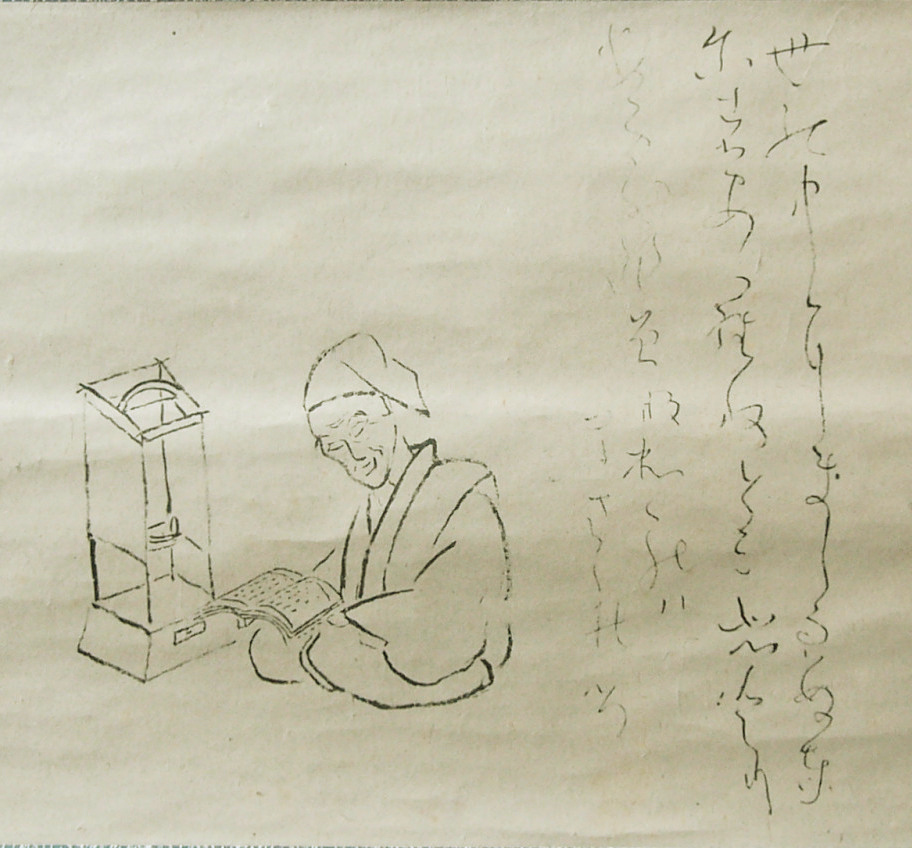
Ryōkan Zitate

Ryōkan war ein Zen-Buddhistischer Mönch der japanischen Sōtō-shū. Die meiste Zeit seines Lebens lebte er als Eremit. Er wurde berühmt auf den Gebieten der Dichtung und der Kalligraphie. Sein Künstlername war Taigu . Er ist auch unter dem Namen Ryōkwan auf Deutsch bekannt. Wikipedia  

✵ 1758 – 1831
Ryōkan Foto
Ryōkan: 18 Zitate0 Gefällt mir

Ryōkan: Zitate auf Englisch

“The rain has stopped, the clouds have drifted away, and the weather is clear again.”

Ryōkan

Zen Poetics of Ryokan (2006)
Kontext: The rain has stopped, the clouds have drifted away, and the weather is clear again.
If your heart is pure, then all things in your world are pure.
Abandon this fleeting world, abandon yourself,
Then the moon and flowers will guide you along the Way.

“In this dream world
We doze
And talk of dreams —
Dream, dream on,
As much as you wish”

Ryōkan

As translated in Lust for Enlightenment : Buddhism and Sex (1990) by John Stevens, p. 28

“Who says my poems are poems?
My poems are not poems.
When you know that my poems are not poems,
Then we can speak of poetry.”

Ryōkan

Variant translation:<br>Who says my poems are poems?<br>My poems are not poems.<br>After you know my poems are not poems,<br>Then we can begin to discuss poetry! <br class="br"> &quot;Zen Poetics of Ryokan&quot; in Simply Haiku: A Quarterly Journal of Japanese Short Form Poetry (Summer 2006) http://www.hermitary.com/articles/ryokan_poetics.html <br class="br">Dewdrops on a Lotus Leaf : Zen Poems of Ryokan (1993)

“Cling to truth and it turns into falsehood. Understand falsehood and it turns into truth.”

Ryōkan

As translated in 1,001 Pearls of Wisdom (2006) by David Ross, p. 36
Kontext: Cling to truth and it turns into falsehood. Understand falsehood and it turns into truth. Truth and falsehood are two sides of the same coin. Neither accept one nor reject the other.

“Easily moved by beauty—such is my nature.
I take a few phrases
and they just turn into poems”

Ryōkan

As translated in Great Fool: Zen Master Ryōkan; Poems, Letters, and Other Writings (1996) by Ryūichi Abé and Peter Haskel, p. 117

“You must rise above
The gloomy clouds
Covering the mountaintop
Otherwise, how will you
Ever see the brightness?”

Ryōkan

As translated in Lust for Enlightenment : Buddhism and Sex (1990) by John Stevens, p. 117

“I take these words as an admonition to myself.”

Ryōkan

Zen Poetics of Ryokan (2006)
Kontext: When you encounter those who are wicked, unrighteous, foolish, dim-witted, deformed, vicious, chronically ill, lonely, unfortunate, or disabled, you should think: “How can I save them?” And even if there is nothing you can do, at least you must not indulge in feelings of arrogance, superiority, derision, scorn, or abhorrence, but should immediately manifest sympathy and compassion. If you fail to do so, you should feel ashamed and deeply reproach yourself: “How far I have strayed from the Way! How can I betray the old sages? I take these words as an admonition to myself.”

“In the scenery of spring,
nothing is better, nothing worse”

Ryōkan

As translated in Haiku : Spring (1950) by Reginald Horace Blyth
Kontext: In the scenery of spring,
nothing is better, nothing worse;
The flowering branches are
of themselves, some short, some long.

“When you encounter those who are wicked, unrighteous, foolish, dim-witted, deformed, vicious, chronically ill, lonely, unfortunate, or disabled, you should think: “How can I save them?””

Ryōkan

Zen Poetics of Ryokan (2006)
Kontext: When you encounter those who are wicked, unrighteous, foolish, dim-witted, deformed, vicious, chronically ill, lonely, unfortunate, or disabled, you should think: “How can I save them?” And even if there is nothing you can do, at least you must not indulge in feelings of arrogance, superiority, derision, scorn, or abhorrence, but should immediately manifest sympathy and compassion. If you fail to do so, you should feel ashamed and deeply reproach yourself: “How far I have strayed from the Way! How can I betray the old sages? I take these words as an admonition to myself.”

“This world
A fading
Mountain echo
Void and
Unreal”

Ryōkan

Dewdrops on a Lotus Leaf : Zen Poems of Ryokan (1993)

“The thief left it behind:
the moon
at my window.”

Ryōkan

Written after a thief robbed his hut, as translated in The Enlightened Heart: An Anthology of Sacred Poetry‎ (1993) by Stephen Mitchell, p. 162

“It's a pity, a gentleman in refined retirement composing poetry:
He models his work on the classic verse of China.
And his poems are elegant, full of fine phrases.
But if you don't write of things deep in your own heart,
What's the use of churning out so many words?”

Ryōkan

Variant translation:
With gaudy words their lines are formed
And further adorned by novel and curious phrases.
Yet if they fail to express what is in their own minds
What is the use, no matter
How many poems they compose!
"Zen Poetics of Ryokan" in Simply Haiku: A Quarterly Journal of Japanese Short Form Poetry (Summer 2006)
Dewdrops on a Lotus Leaf : Zen Poems of Ryokan (1993)

“The winds gives me
Enough fallen leaves
To make a fire”

Ryōkan

Dewdrops on a Lotus Leaf : Zen Poems of Ryokan (1993)

Ähnliche Autoren

George Gordon Byron Foto
George Gordon Byron25
britischer Dichter None
Carl Spitteler Foto
Carl Spitteler16
Schweizer Dichter und Schriftsteller None
Hans Christian Andersen Foto
Hans Christian Andersen17
dänischer Dichter und Schriftsteller None
William Blake Foto
William Blake27
englischer Maler und Dichter None
Giacomo Leopardi Foto
Giacomo Leopardi12
italienischer Dichter und Philologe None
Frédéric Mistral Foto
Frédéric Mistral1
französischer Dichter und Linguist, Nobelpreisträger für Li… None
Arthur Rimbaud Foto
Arthur Rimbaud6
französischer Dichter, Abenteurer und Geschäftsmann None
Heinrich Heine Foto
Heinrich Heine104
deutscher Dichter und Publizist None
Walt Whitman Foto
Walt Whitman42
US-amerikanischer Dichter None
Samuel Taylor Coleridge Foto
Samuel Taylor Coleridge3
englischer Dichter, Kritiker und Philosoph None