“To bend and prostrate oneself to express sentiments of respect, appears to be a natural motion.”
Modes of Salutation, and Amicable Ceremonies, Observed in Various Nations.
Curiosities of Literature (1791–1834)
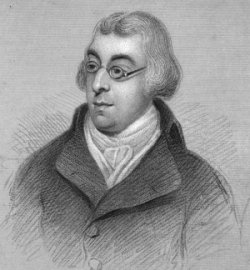
Isaak D’Israeli war ein englischer Schriftsteller und Literaturhistoriker.
Isaak D'Israeli war der einzige Sohn von Benjamin D'Israeli , einem Großhändler, der aus der italienischen Stadt Cento stammte und sich 1748 in England niederließ, wo er erst 1801 eingebürgert wurde. Isaak war nicht religiös, sondern durch die Gedanken der Aufklärung beeinflusst. Im Jahre 1802 heiratete er Maria Basevi , die ebenfalls einer in London ansässigen Familie italienisch-jüdischer Herkunft entstammte. Das Paar hatte fünf Kinder: Sarah , Benjamin , Naphtali , Raphael und Jacobus . Die Kinder erhielten ihre Namen nach jüdischen Traditionen, und die Söhne wurden alle beschnitten. Auf den Rat seines Freundes, des Historikers Sharon Turner, und infolge jahrelanger Auseinandersetzungen mit der Bevis-Marks-Synagoge wurden jedoch 1817 alle seine Kinder in der Church of England getauft. Er selbst trat zwar nicht zum Christentum über, ließ sich aber auf einem nichtjüdischen Friedhof beerdigen.
Literarische Bekanntheit erlangte er mit Curiosities of Literature, einer Sammlung von Anekdoten über berühmte Persönlichkeiten, Bücher und die Hobbys von Büchersammlern. 1828 wurde seine Biographie über Karl I. veröffentlicht, die im 19. Jahrhundert hohe Popularität genoss und derentwegen er von der Universität Oxford mit dem Grad eines Ehrendoktors ausgezeichnet wurde.
Sein zweites Kind, der zweimalige britische Premierminister Benjamin Disraeli, hinterließ im Rahmen seiner Werkausgaben auch biographische Notizen über seinen Vater.
Wikipedia
“To bend and prostrate oneself to express sentiments of respect, appears to be a natural motion.”
Modes of Salutation, and Amicable Ceremonies, Observed in Various Nations.
Curiosities of Literature (1791–1834)
“The negroes are lovers of ludicrous actions, and hence all their ceremonies seem farcical.”
Modes of Salutation, and Amicable Ceremonies, Observed in Various Nations.
Curiosities of Literature (1791–1834)
Quelle: The Literary Character, Illustrated by the History of Men of Genius (1795–1822), Ch. IV.
Royal Promotions.
Curiosities of Literature (1791–1834)
Quelle: The Literary Character, Illustrated by the History of Men of Genius (1795–1822), Ch. III.
“The wisdom of the wise, and the experience of ages, may be preserved by quotation.”
Quotation; since at least 1986 a paraphrased form misattributed to his son Benjamin Disraeli has often been quoted: "The wisdom of the wise and the experience of the ages are perpetuated by quotations."
Curiosities of Literature (1791–1834)
“Plagiarists, at least, have the merit of preservation.”
Of Suppressors and Dilapidators of Manuscripts.
Curiosities of Literature (1791–1834)
“Candour is the brightest gem of criticism.”
Literary Journals.
Curiosities of Literature (1791–1834)
Quelle: The Literary Character, Illustrated by the History of Men of Genius (1795–1822), Ch. VIII.
“Every production of genius must be the production of enthusiasm.”
Solitude.
Curiosities of Literature (1791–1834)
Quelle: The Literary Character, Illustrated by the History of Men of Genius (1795–1822), Ch. III.
Introduction.
The Literary Character, Illustrated by the History of Men of Genius (1795–1822)
“Mediocrity can talk, but it is for genius to observe.”
Men of Genius Deficient in Conversation.
Curiosities of Literature (1791–1834)
Literary Fashions.
Curiosities of Literature (1791–1834)


