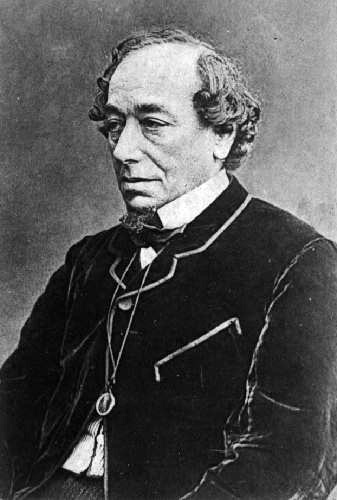
Benjamin Disraeli Zitate
seite 7

Benjamin Disraeli, 1. Earl of Beaconsfield , war ein konservativer britischer Staatsmann und erfolgreicher Romanschriftsteller. Zweimal, 1868 und von 1874 bis 1880, bekleidete er das Amt des britischen Premierministers. Wikipedia  

✵ 21. Dezember 1804 – 19. April 1881
Benjamin Disraeli Foto
Benjamin Disraeli: 310 Zitate3 Gefällt mir

Benjamin Disraeli Berühmte Zitate

„Nein, besser nicht. Sie wird mich nur bitten, Albert eine Nachricht zu bringen.“

Benjamin Disraeli

Letzte Worte, 19. April 1881; er lehnte ein Angebot der Königin Viktoria ab, ihn zu besuchen; gemeint war Viktorias verstorbener Mann Albert von Sachsen-Coburg und Gotha
Original engl.: "No, it is better not. She will only ask me to take a message to Albert." - Fred R. Shapiro: The Yale book of quotations, Yale University Press 2006, Seite 208, zitiert nach Robert Blake: Disraeli, 1966

„Du siehst also, lieber Coningsby, dass die Welt von ganz anderen Personen regiert wird als diejenigen es sich vorstellen, die nicht hinter den Kulissen stehen.“

Benjamin Disraeli buch Coningsby

Romanfigur Sidonia zu Romanfigur Coningsby, im Roman Coningsby oder die neue Generation, Ins Deutsche übertragen von August Kretzschmar, Verlags-Comptoir Grimma 1845,
Original: (en) So you see, my dear Coningsby, that the world is governed by very different personages from what is imagined by those who are not behind the scenes.
Quelle: Coningsby, Buch 4, Kapitel 15, 1844

„Es gibt drei Arten von Lügen: Lügen, verdammte Lügen und Statistiken.“

Benjamin Disraeli

Diesen Ausspruch schreibt ihm fälschlich Mark Twain in seiner Autobiographie zu. Tatsächlich von Leonard Henry Courtney 1895. york.ac.uk http://www.york.ac.uk/depts/maths/histstat/lies.htm <br class="br">Original engl.: &quot;There are three kinds of lies - lies, damned lies, and statistics.&quot; <br class="br">Fälschlich zugeschrieben

Benjamin Disraeli: Zitate auf Englisch

“The right hon. Gentleman caught the Whigs bathing, and walked away with their clothes. He has left them in the full enjoyment of their liberal position, and he is himself a strict conservative of their garments.”

Benjamin Disraeli

Quelle: Speech http://hansard.millbanksystems.com/commons/1845/feb/28/opening-letters-at-the-post-office in the House of Commons (28 February 1845), referring to Sir Robert Peel.

“I suppose, to use our national motto, something will turn up.”

Benjamin Disraeli

Popanilla http://www.gutenberg.org/etext/7816 (1827) Ch. 7 referring to the Motto of &quot;Vraibleusia&quot;. <br class="br">Books

“In assuming that peace will be maintained, I assume also that no Great Power would shrink from its responsibilities. If there be a country, for example, one of the most extensive and wealthiest of empires in the world—if that country, from a perverse interpretation of its insular geographical position, turns an indifferent ear to the feelings and the fortunes of Continental Europe, such a course would, I believe, only end in its becoming an object of general plunder. So long as the power and advice of England are felt in the councils of Europe, peace, I believe, will be maintained, and maintained for a long period. Without their presence, war, as has happened before, and too frequently of late, seems to me to be inevitable. I speak on this subject with confidence to the citizens of London, because I know that they are men who are not ashamed of the Empire which their ancestors created; because I know that they are not ashamed of the noblest of human sentiments, now decried by philosophers—the sentiment of patriotism; because I know they will not be beguiled into believing that in maintaining their Empire they may forfeit their liberties. One of the greatest of Romans, when asked what were his politics, replied, Imperium et Libertas.”

Benjamin Disraeli

That would not make a bad programme for a British Ministry. It is one from which Her Majesty's advisers do not shrink.
Quelle: Speech at the Guildhall, London (9 November 1879), cited in William Flavelle Monypenny and George Earle Buckle, The Life of Benjamin Disraeli, Earl of Beaconsfield, Vol. 2 (1929), pp. 1366-7.

“Upon the education of the people of this country the fate of this country depends.”

Benjamin Disraeli

Quelle: Speech http://hansard.millbanksystems.com/commons/1874/jun/15/motion-for-a-select-committee in the House of Commons (15 June 1874).

“Though I sit down now, the time will come when you will hear me.”

Benjamin Disraeli

Maiden speech https://www.oxfordreference.com/view/10.1093/acref/9780191843730.001.0001/q-oro-ed5-00003685 in the House of Commons (7 December 1837). Disraeli was being shouted down by other MPs. Compare: &quot;I will be heard&quot;, William Lloyd Garrison, Salutatory of the Liberator <br class="br">1830s

“The more extensive an author's knowledge of what has been done, the greater will be his power of knowing what to do.”

Benjamin Disraeli

Isaac D'Israeli, Curiosities of Literature.
Misattributed, Isaac D'Israeli

“A consistent man believes in Destiny — a capricious man in Chance.”

Benjamin Disraeli

Book VI, Chapter 22.
Books, Coningsby (1844), Vivian Grey (1826)

“It is knowledge that influences and equalises the social condition of man; that gives to all, however different their political position, passions which are in common, and enjoyments which are universal.”

Benjamin Disraeli

"The Value of Literature to Men of Business," speech at the Manchester Athenaeum (23 October 1844), cited in Selected Speeches of the Late Right Honourable the Earl of Beaconsfield, Vol. 2 (1882), p. 625.
1840s

“…reciprocity is barter. I always understood that barter was the last effort of civilization that it was exactly that state of human exchange that separated civilization from savagery; and if reciprocity is only barter, I fear that would hardly help us out of our difficulty. My noble friend read some extracts from the speeches of those who had the misfortune to be in Parliament at that time, and he honoured me by reading an extract from the speech I then made in the other House of Parliament. That was a speech in favour of reciprocity, and indicated the means by which reciprocity could be obtained. That is to say…by the negotiation of a treaty of commerce, by reciprocal exchange and the lowering of duties, the products of the two negotiating countries would find a freer access and consumption in the two countries than they formerly possessed. But when he taunts me with his quotation of some musty phrases of mine 40 years ago, I must remind him that we had elements then on which treaties of reciprocity could be negotiated. At that time, although the great changes of Sir Robert Peel had taken place, there were 168 articles in the tariff which were materials by which you could have negotiated, if that was a wise and desirable policy, commercial treaties of reciprocity. What is the number you now have in the tariff? Twenty-two. Those who talk of negotiating treaties of reciprocity…have they the materials for negotiating treaties of reciprocity? You have lost the opportunity. I do not want to enter into the argument at the present moment; but England cannot pursue that policy.”

Benjamin Disraeli

Speech in the House of Lords (29 April 1879), reported in The Times (30 April 1879), p. 8.
1870s

“A University should be a place of light, of liberty, and of learning.”

Benjamin Disraeli

Quelle: Speech http://hansard.millbanksystems.com/commons/1873/mar/11/second-reading-adjourned-debate in the House of Commons (11 March 1873).

“Increased means and increased leisure are the two civilizers of man.”

Benjamin Disraeli

Quelle: Speech to the Conservatives of Manchester (3 April 1872), cited in The World's Best Orations from the Earliest Period to the Present Time, Vol. 1 (eds. David Josiah Brewer, Edward Archibald Allen, William Schuyler), pp. 309-338.

“Gentlemen, the Tory party, unless it is a national party, is nothing.”

Benjamin Disraeli

Quelle: Speech at banquet of the National Union of Conservative and Constitutional Associations, Crystal Palace, London (24 June 1872), cited in "Mr. Disraeli at Sydenham," The Times (25 June 1872), p. 7.

“There is no education like adversity.”

Benjamin Disraeli

Quelle: Books, Coningsby (1844), Endymion (1880), Ch. 61.

“Something unpleasant is coming when men are anxious to tell the truth.”

Benjamin Disraeli

Book IV, Chapter 6.
Books, Coningsby (1844), The Young Duke (1831)

“The fool wonders, the wise man asks.”

Benjamin Disraeli

Count Alarcos: A Tragedy Act IV, sc. i.
Books

Ähnliche Autoren

George Gordon Byron Foto
George Gordon Byron25
britischer Dichter None
Emily Brontë Foto
Emily Brontë8
britische Schriftstellerin None
Lewis Carroll Foto
Lewis Carroll14
britischer Schriftsteller, Mathematiker und Fotograf None
Thomas Hardy Foto
Thomas Hardy9
englischer Schriftsteller None
Mary Shelley Foto
Mary Shelley9
britische Schriftstellerin None
John Ruskin Foto
John Ruskin4
englischer Schriftsteller, Maler, Kunsthistoriker und Sozia… None
Percy Bysshe Shelley Foto
Percy Bysshe Shelley4
englischer Schriftsteller None
Jane Austen Foto
Jane Austen89
britische Schriftstellerin None
Charles Darwin Foto
Charles Darwin46
britischer Naturforscher, Begründer der modernen Evolutions… None
George Eliot Foto
George Eliot10
englische Schriftstellerin None