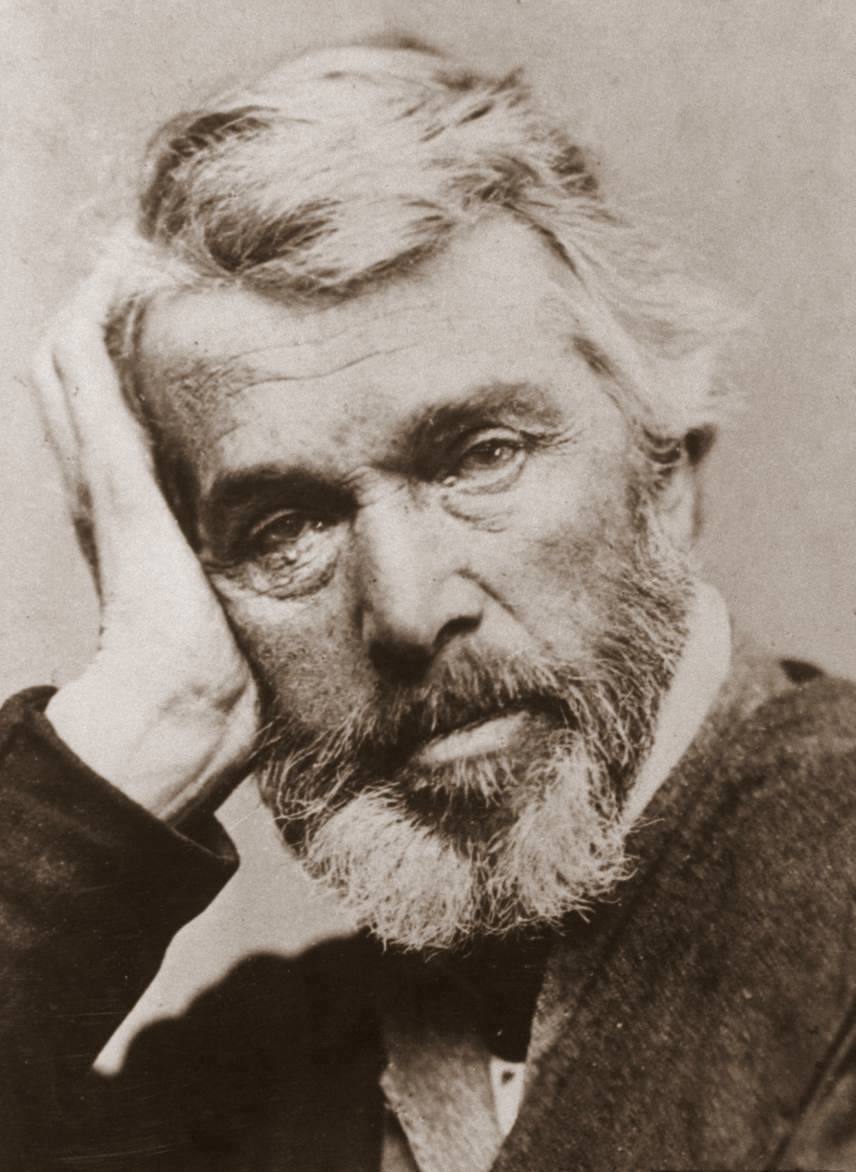
Thomas Carlyle Zitate
seite 4

Thomas Carlyle war ein schottischer Essayist und Historiker, der im viktorianischen Großbritannien sehr einflussreich war. Wikipedia  

✵ 4. Dezember 1795 – 5. Februar 1881  •  Andere Namen Томас Карлайл
Thomas Carlyle Foto
Thomas Carlyle: 487 Zitate6 Gefällt mir

Thomas Carlyle Berühmte Zitate

„Das, was wir den Tod nennen, ist in Wahrheit der Anfang des Lebens.“

Thomas Carlyle buch Characteristics

Original engl.: "... and Death, what mortals call Death, properly the beginning of Life." - Critical and miscellaneous essays. A new edition. Vol. 5. Boston 1855, S. 301 (aus "Characteristics", Edinburgh Review 1831)

„Glücklich, wer seinen Beruf erkannt hat. Er verlange nach keinem andern Glück!“

Thomas Carlyle buch Past and Present

Past and Present, 1843, Book III, chapter XI: Labour
Original engl.: "Blessed is he who has found his work; let him ask no other blessedness."

„Ein Register ohne Buch hat mir manchmal genützt, ein Buch ohne Register nie.“

Thomas Carlyle

Zitiert nach Ludwig Reiners: Stilkunst. München 1991, S. 509. ISBN 3406349854
Zugeschrieben

Thomas Carlyle: Zitate auf Englisch

“The true University of these days is a Collection of Books.”

Thomas Carlyle

1840s, Heroes and Hero-Worship (1840), The Hero as Man of Letters
Quelle: On Heroes, Hero Worship and the Heroic in History

“Every noble work is at first impossible.”

Thomas Carlyle

From Past and Present (1843), Chapter XI : Labour
The Wikipedia page for Thomas Carlyle has links to the Project Gutenberg version of this book
1840s

“He that works and does some Poem, not he that merely says one, is worthy of the name of Poet.”

Thomas Carlyle

Introduction to Cromwell's Letters and Speeches (1845).
1840s

“A witty statesman said, you might prove anything by figures.”

Thomas Carlyle

Quelle: 1840s, Chartism (1840), Ch. 2, Statistics.

“… I must say, it [the Koran] is as toilsome reading as I ever undertook. A wearisome confused jumble, crude, incondite; endless iterations, long-windedness, entanglement; most crude, incondite; — insupportable stupidity, in short! Nothing but a sense of duty could carry any European through the Koran … It is the confused ferment of a great rude human soul; rude, untutored, that cannot even read; but fervent, earnest, struggling vehemently to utter itself in words … We said "stupid:" yet natural stupidity is by no means the character of Mahomet's Book; it is natural uncultivation rather. The man has not studied speaking; in the haste and pressure of continual fighting, has not time to mature himself into fit speech … The man was an uncultured semi-barbarous Son of Nature, much of the Bedouin still clinging to him: we must take him for that. But for a wretched Simulacrum, a hungry Impostor without eyes or heart … we will not and cannot take him. Sincerity, in all senses, seems to me the merit of the Koran; what had rendered it precious to the wild Arab men … Curiously, through these incondite masses of tradition, vituperation, complaint, ejaculation in the Koran, a vein of true direct insight, of what we might almost call poetry, is found straggling.”

Thomas Carlyle buch On Heroes, Hero-Worship, and The Heroic in History

Thomas Carlyle, "On Heroes, Hero-Worship and the Heroic in History" (1841), pg. 64-67
1840s

“It depends on what we read, after all manner of Professors have done their best for us.”

Thomas Carlyle

1840s, Heroes and Hero-Worship (1840), The Hero as Man of Letters

“O poor mortals, how ye make this earth bitter for each other.”

Thomas Carlyle

Pt. I, Bk. V, ch. 5.
1830s, The French Revolution. A History (1837)

“History is the essence of innumerable biographies.”

Thomas Carlyle

On History.
1820s, Critical and Miscellaneous Essays (1827–1855)

“To the very last, he had a kind of idea; that, namely, of la carrière ouverte aux talents,—the tools to him that can handle them.”

Thomas Carlyle

On Napoleon; Carlyle in his essay on Mirabeau, 1837, quotes this from a "New England book".
1830s, Sir Walter Scott (1838)

“What is all Knowledge too, but recorded Experience, and a product of History; of which, therefore, Reasoning and Belief, no less than Action and Passion, are essential materials.”

Thomas Carlyle

On History.
1820s, Critical and Miscellaneous Essays (1827–1855)
Variante: What is all Knowledge too, but recorded Experience, and a product of History; of which, therefore, Reasoning and Belief, no less than Action and Passion, are essential materials.

“The history of the world is but the biography of great men.”

Thomas Carlyle

1840s, Heroes and Hero-Worship (1840), The Hero as Divinity

Ähnliche Autoren

Robert Louis Balfour Stevenson Foto
Robert Louis Balfour Stevenson1
schottischer Schriftsteller None
Theodor Mommsen Foto
Theodor Mommsen7
deutscher Historiker und Altertumswissenschaftler None
Carl Spitteler Foto
Carl Spitteler16
Schweizer Dichter und Schriftsteller None
Giacomo Leopardi Foto
Giacomo Leopardi12
italienischer Dichter und Philologe None
Elbert Hubbard Foto
Elbert Hubbard36
US-amerikanischer Schriftsteller und Verleger None
Stendhal Foto
Stendhal27
französischer Schriftsteller im 19. Jahrhundert None
Søren Kierkegaard Foto
Søren Kierkegaard39
dänischer Philosoph, Essayist, Theologe und religiöser Schr… None
Heinrich Heine Foto
Heinrich Heine104
deutscher Dichter und Publizist None
Karl Marx Foto
Karl Marx153
deutscher Philosoph, Ökonom und Journalist None
Friedrich Engels Foto
Friedrich Engels42
deutscher Politiker, Unternehmer, Philosoph und Militärhist… None