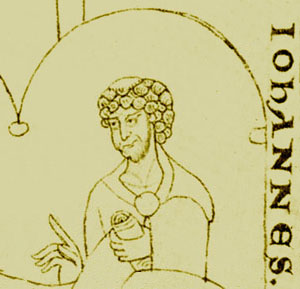
Johannes Scottus Eriugena Zitate

Johannes Scottus Eriugena war ein Gelehrter irischer Herkunft, der im Westfrankenreich als theologischer und philosophischer Schriftsteller hervortrat und als Lehrer der Sieben Freien Künste tätig war. Er lebte am Hof Karls des Kahlen, eines für Belange des Bildungswesens aufgeschlossenen Königs, dessen Hofdichter er war.

Mit seinen guten, wenn auch nicht hervorragenden Griechischkenntnissen war Eriugena unter den Gelehrten seiner Zeit eine Ausnahmeerscheinung. Als Übersetzer und Kommentator leistete er einen gewichtigen Beitrag zur Verbreitung griechischen Gedankenguts aus der Epoche der Kirchenväter im lateinischsprachigen Westen. Damit stärkte er zugleich den Einfluss des Neuplatonismus in der abendländischen Geistesgeschichte. Mit seinem Bemühen um eine durchdachte, logisch einwandfreie Vorgehensweise in der theologischen Argumentation nahm er Entwicklungen der hoch- und spätmittelalterlichen Scholastik vorweg. Bei seinen Zeitgenossen erregte er damit und mit seiner allegorischen statt historischen Bibelauslegung Anstoß. Seine kühnen Thesen wurden wiederholt kirchlich verurteilt. Wikipedia  

✵ 810 – 877
Johannes Scottus Eriugena Foto
Johannes Scottus Eriugena: 8 Zitate0 Gefällt mir

Johannes Scottus Eriugena: Zitate auf Englisch

“Pultes Scotorum.”

John Scotus Eriugena

Irish porridge.

Verdict of the Fourth Council of Valence, 855, on his De Divina Praedestinatione, cited from Ferdinand Christian Baur Die christliche Kirche des Mittelalters in den Haupmomenten ihrer Entwicklung (Tübingen: Fues, 1861) p. 56; translation from Andrew Gibson James Joyce (London: Reaktion, 2006) p. 62.
Criticism

“Synthesizing as it does the philosophical accomplishments of fifteen centuries, this book appears as the final achievement of ancient philosophy.”

John Scotus Eriugena

George Bosworth Burch Early Medieval Philosophy (New York: King’s Crown Press, 1951) p. 5.

Of De Divisione Naturae.
Criticism

“No one enters heaven except through philosophy.”

John Scotus Eriugena

Annotationes in Marciam, no. 64; translation from John Joseph O’Meara Eriugena (Oxford: Clarendon Press, 1988) p. 30.
Original: (la) Nemo intrat in caelum nisi per philosophiam.

“The breadth of the table.”

John Scotus Eriugena

Original: (la) Tabula tantum.

William of Malmesbury Gesta Pontificum, Bk. 5; translation from Helen Waddell The Wandering Scholars (Harmondsworth: Penguin, [1927] 1954) p. 78.

His reply to Charles the Bald's taunt, as they sat at the same table, "Quid distat inter sottum et Scottum?", (How far is an Irishman from a drunkard?).

“What, then, is it to treat of philosophy, unless to lay down the rules of the true religion by which we seek rationally and adore humbly God, who is the first and sovereign cause of all things? Hence it follows that the true philosophy is the true religion, and reciprocally that the true religion is the true philosophy.”

John Scotus Eriugena

Original: (la) Quid est aliud de philosophia tractare, nisi verae religionis, qua summa et principalis omnium rerum causa, Deus, et humiliter colitur, et rationabiliter investigatur, regulas exponere? Conficitur inde, veram esse philosophiam veram religionem, conversimque veram religionem esse veram philosophiam.

De Divina Praedestinatione, ch. 1; translation from Kenelm Henry Digby Mores Catholici, vol. 8 (London: Booker & Dolman, 1837) p. 198.

“For authority proceeds from true reason, but reason certainly does not proceed from authority. For every authority which is not upheld by true reason is seen to be weak, whereas true reason is kept firm and immutable by her own powers and does not require to be confirmed by the assent of any authority.”

John Scotus Eriugena buch De divisione naturae

Original: (la) Auctoritas siquidem ex vera ratione processit, ratio vero nequaquam ex auctoritate. Omnis enim auctoritas, quae vera ratione non approbatur, infirma videtur esse. Vera autem ratio, quum virtutibus suis rata atque immutabilis munitur, nullius auctoritatis adstipulatione roborari indigent.

De Divisione Naturae, Bk. 1, ch. 69; translation by I. P. Sheldon-Williams, cited from Peter Dronke (ed.) A History of Twelfth-Century Western Philosophy (Cambridge: CUP, 1988) p. 2.

“When we are told that God is the maker of all things, we are simply to understand that God is in all things – that He is the substantial essence of all things.”

John Scotus Eriugena buch De divisione naturae

Original: (la) Cum ergo audimus, Deum omnia facere, nil aliud debemus intelligere, quam Deum in omnibus esse, hoc est, essentiam omnium subsistere.

De Divisione Naturae, Bk. 1, ch. 72; translation from Hugh Fraser Stewart Boethius: An Essay (London: William Blackwood, 1891) p. 255.

“One man stands head and shoulders above his contemporary scholars: head and shoulders, some hold, above the Middle Ages: John Scotus Erigena.”

John Scotus Eriugena

Helen Waddell The Wandering Scholars (Harmondsworth: Penguin, [1927] 1954) pp. 77-78.
Criticism

Ähnliche Autoren

Anselm von Canterbury Foto
Anselm von Canterbury72
Theologe und Philosoph des Mittelalters None
Thomas von Aquin Foto
Thomas von Aquin97
dominikanischer Philosoph und Theologe None
Roger Bacon Foto
Roger Bacon1
englischer Philosoph None
Meister Eckhart Foto
Meister Eckhart11
spätmittelalterlicher Theologe und Philosoph None
Omar Khayyam Foto
Omar Khayyam24
persischer Mathematiker, Astronom, Philosoph und Dichter None
Anicius Manlius Boëthius Foto
Anicius Manlius Boëthius9
spätantiker römischer Philosoph und Staatsmann None
Petrus Abaelardus Foto
Petrus Abaelardus10
Philosoph des Mittelalters und Vertreter der Frühscholastik None
Dante Alighieri Foto
Dante Alighieri65
italienischer Dichter und Philosoph None
Jan Hus Foto
Jan Hus3
christlicher Reformator und Märtyrer None
Ramon Llull Foto
Ramon Llull2
katalanischer Philosoph, Logiker und Theologe None