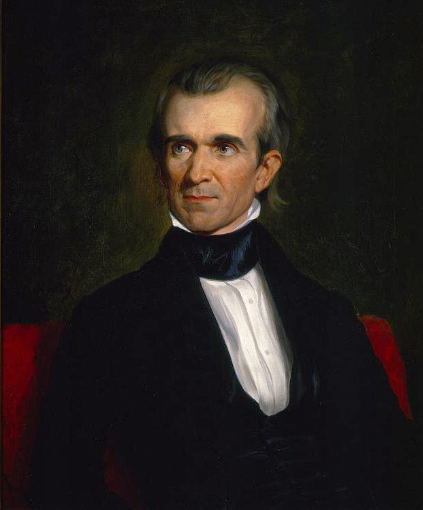
Diary entry (29 December 1848).
Kontext: No president who performs his duties faithfully and conscientiously can have any leisure. If he entrusts the details and smaller matters to subordinates constant errors will occur. I prefer to supervise the whole operations of the government myself rather than entrust the public business to subordinates, and this makes my duties very great.
James K. Polk: 15 Zitate0 Gefällt mir
James K. Polk: Zitate auf Englisch
Inaugural Address (4 March 1845).
Kontext: Although in our country the Chief Magistrate must almost of necessity be chosen by a party and stand pledged to its principles and measures, yet in his official action he should not be the President of a part only, but of the whole people of the United States. While he executes the laws with an impartial hand, shrinks from no proper responsibility, and faithfully carries out in the executive department of the Government the principles and policy of those who have chosen him, he should not be unmindful that our fellow-citizens who have differed with him in opinion are entitled to the full and free exercise of their opinions and judgments, and that the rights of all are entitled to respect and regard.
“No president who performs his duties faithfully and conscientiously can have any leisure.”
Diary entry (29 December 1848).
Kontext: No president who performs his duties faithfully and conscientiously can have any leisure. If he entrusts the details and smaller matters to subordinates constant errors will occur. I prefer to supervise the whole operations of the government myself rather than entrust the public business to subordinates, and this makes my duties very great.
Inaugural Address (4 March 1845)
Kontext: By the theory of our Government majorities rule, but this right is not an arbitrary or unlimited one. It is a right to be exercised in subordination to the Constitution and in conformity to it. One great object of the Constitution was to restrain majorities from oppressing minorities or encroaching upon their just rights. Minorities have a right to appeal to the Constitution as a shield against such oppression.
“Foreign powers do not seem to appreciate the true character of our Government.”
Inaugural Address (4 March 1845).
Fourth Annual Message to Congress (5 December 1848) http://memory.loc.gov/cgi-bin/query/r?ammem/hlaw:@field(DOCID+@lit(sj0404)).
“I love you Sarah. For all eternity, I love you.”
Last words, spoken to his wife (15 June 1849); as quoted in Famous Last Words: The Ultimate Collection of Finales and Farewells (2004) by Laura Ward.
First Annual Message to Congress (2 December 1845) http://memory.loc.gov/cgi-bin/query/r?ammem/hlaw:@field(DOCID+@lit(sj0374)):.
“The world has nothing to fear from military ambition in our Government.”
Inaugural Address (4 March 1845).
“With me it is emphatically true that the presidency is "no bed of roses."”
Diary entry (4 September 1847).
Diary entry (22 June 1846).
Inaugural Address (4 March 1845) http://www.yale.edu/lawweb/avalon/presiden/inaug/polk.htm.


