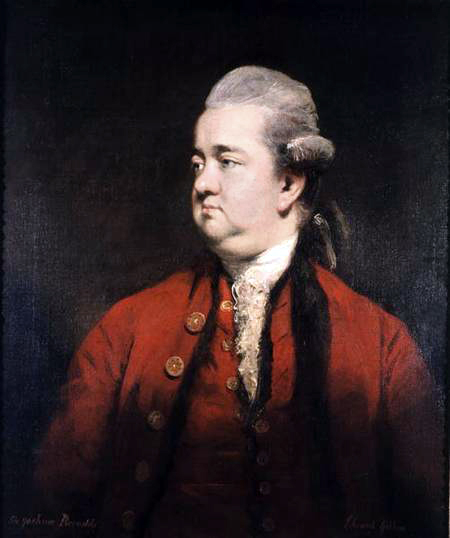
aus Geschichte des Verfalls und Untergangs des Römischen Reiches, Übersetzung: Nino Barbieri <br class="br">Original engl.: " The theologian may indulge the pleasing task of describing Religion as she descended from Heaven, arrayed in her native purity. A more melancholy duty is imposed on the historian. He must discover the inevitable mixture of error and corruption which she contracted in a long residence upon earth, among a weak and degenerate race of beings." - "The decline and Fall of the Roman Empire", chap. XV http://books.google.de/books?id=PrwWAAAAQAAJ&pg=PA450&dq=theologian
Edward Gibbon: 46 Zitate0 Gefällt mir
Edward Gibbon Berühmte Zitate
Geschichte des Verfalls und Untergangs des Römischen Reiches <br class="br">"Antoninus diffused order and tranquillity over the greatest part of the earth. His reign is marked by the rare advantage of furnishing very few materials for history; which is, indeed, little more than the register of the crimes, follies, and misfortunes of mankind." - "The decline and Fall of the Roman Empire", chap. III ccel.org http://www.ccel.org/g/gibbon/decline/volume1/chap3.htm
„Wind und Wellen sind immer auf der Seite des besseren Seefahrers.“
Geschichte des Verfalls und Untergang des Römischen Reiches <br class="br">"the winds and waves are always on the side of the ablest navigators." - "The decline and Fall of the Roman Empire", chap. LXVIII ccel.org http://www.ccel.org/g/gibbon/decline/volume2/chap68.htm
Edward Gibbon: Zitate auf Englisch
Vol. 1, Ch. 3 "Of the Constitution of the Roman Empire, in the Age of the Antonines" http://www.ccel.org/ccel/gibbon/decline/files/volume1/chap3.htm <br class="br">This has often been paraphrased: History is indeed little more than the register of crimes, follies, and misfortunes of mankind. <br class="br">The Decline And Fall Of The Roman Empire: Volume 1 (1776)
“Crowds without company, and dissipation without pleasure.”
Referring to London.
Memoirs (1796)
“I was never less alone than when by myself.”
Vol. i. p. 117. Compare: "Never less alone than when alone", Samuel Rogers, Human Life; "In solitude, where we are least alone", Lord Byron, Childe Harold's Pilgrimage, Canto III, Stanza 90.
Memoirs (1796)
Vol. 1, Chap. 71.
The Decline And Fall Of The Roman Empire: Volume 1 (1776)
“In every deed of mischief he had a heart to resolve, a head to contrive, and a hand to execute.”
Vol. 1, Chap. 48. Compare: "He had a head to contrive, a tongue to persuade, and a hand to execute any mischief", Edward Hyde, 1st Earl of Clarendon (on Hampden), History of the Rebellion, Vol. iii, Book vii, Section 84.
The Decline And Fall Of The Roman Empire: Volume 1 (1776)
Vol. i. p. 106. Compare: "None ever loved but at first sight they loved", George Chapman, The Blind Beggar of Alexandria.
Memoirs (1796)
Vol. 1, Chap. 10.
The Decline And Fall Of The Roman Empire: Volume 1 (1776)
Vol. 1, Chap. 10.
The Decline And Fall Of The Roman Empire: Volume 1 (1776)
Vol. 1, Chap. 10.
The Decline And Fall Of The Roman Empire: Volume 1 (1776)
“All gates are shut against the unfortunate.”
Vol. III
The Decline And Fall Of The Roman Empire: Volume 1 (1776)
EGPaIV" Edward Gibbon, [1788], Decline and Fall of the Roman Empire http://www.sacred-texts.com/cla/gibbon/05/daf05010.htm, Vol. 5, Chapter L: Description Of Arabia And Its Inhabitants. Part IV. <br class="br">The Decline And Fall Of The Roman Empire: Volume 1 (1776)


