“We are more than a people…. We are of a pure blood.”
Verk, edited by Kletzkin, xi. 277.
Jizchok Leib Perez war ein jiddischsprachiger Schriftsteller aus Polen, der allerdings auch auf Polnisch und Hebräisch schrieb.
Im seinerzeitigen Polen wurde sein Name als Icchok Lejbusz Perec wiedergegeben, darüber hinaus gibt es bedingt durch Transkriptionen, Transliterationen oder Anpassungen an die in anderen Diasporen übliche Vornamenschreibungen viele weitere Namensformen: Jizchak Leib Perez, Isaak Leib Perez, Jizchok Lejb Perez, Itzhok Lejb Perez, Isaak Leib Peretz usw. Als Feuilletonist benutzte er die Pseudonyme Luzifer, Lez und Ben Tamar.
Neben Mendele Moicher Sforim und Scholem Alejchem gehört Perez zu den Begründern der modernen jiddischen Literatur sowie der jüdischen Belletristik überhaupt. Er gilt „als einer der bedeutendsten psychologisierenden Dichter der Weltliteratur und gleichzeitig als der hervorragendste jiddische Dramatiker“.Perez verfasste sein literarisches Werk in polnischer, hebräischer und in jiddischer Sprache. Sein Frühwerk ist noch ganz in der jüdischen Emanzipation und Aufklärung verhaftet. Nach der gescheiterten Revolution von 1905 thematisierte er in realistischen Novellen die Lebensprobleme der chassidischen Juden in Osteuropa. In seinem Spätwerk trat diese Resignation immer mehr in den Hintergrund, zugunsten seiner symbolhaften Dramen, in denen die Mystik einen sehr großen Stellenwert einnahm. Wikipedia
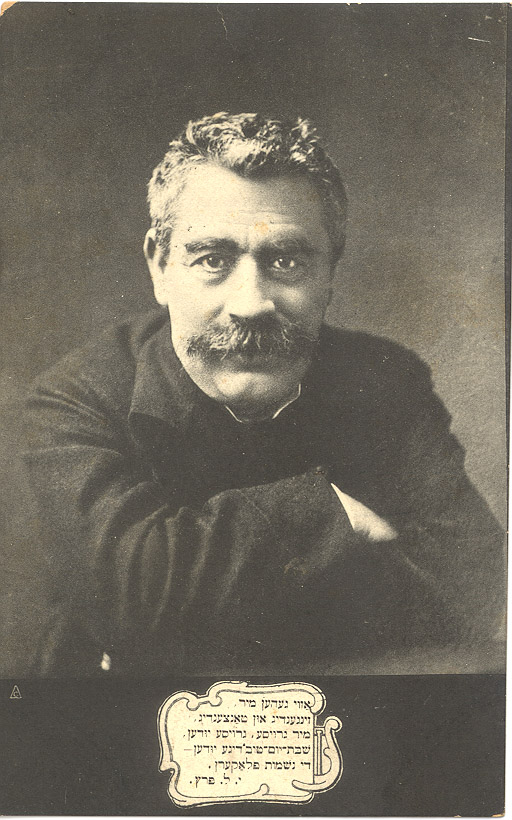
“We are more than a people…. We are of a pure blood.”
Verk, edited by Kletzkin, xi. 277.
“Nobody ever stubs his toe against a mountain. It's the little temptations that bring a man down.”
All for a Pinch of Snuff, c. 1910. Quoted in M. Samuel. Prince of the Ghetto. Alfred A. Knopf, 1948, p. 64.
“Who tells the truth needs no fancy phrases.”
Yohanan Melameds Maaselach, 1904. Alle Verk, vi. 181.
Sewing the Wedding Gown, 1906. Nine One-Act Plays from Yiddish. Translated by Bessie F. White, Boston, John W. Luce & Co., 1932, p. 127.
“A stranger's rose is but a thorn.”
In Alien Lands, translated by Leah W. Leonard.
“In this world it is very dangerous to be weak.”
Shreib a Feleton, 1895. Alle Verk, xii. 77.
"I Am a Rainworm", 1900, translated by Jacob Robbins. J. Leftwich. Golden Peacock. Sci-Art, 1939, p. 83.
The Day, 1906. Alle Verk, xii. 319. S. Liptzin. Peretz. Yivo, 1947, p. 18.
“To be of the eternal, you must be of the earth.”
Der Dichter, 1910. Alle Verk, x. 19.
Mesiras Nefesh, c. 1910. Alle Verk, vii. 142. M. Samuel. Prince of the Ghetto. Alfred A. Knopf, 1948, p. 22.
“If the husband sits on a chair in the Garden of Eden, his wife is his footstool.”
Sholom Bayis, 1889. S. Liptzin. Peretz. Yivo, 1947, p. 153.
“One God, one Law, one people, and one land.”
Der Dichter, 1910. Alle Verk, x. 21.
“Children… constitute man's eternity.”
Der Dichter, 1910. S. Liptzin. Peretz. Yivo, 1947, p. 321.
“At the Throne of Glory it is not the nobly-born that are beloved, but the nobly-risen.”
Drei Matones, c. 1910. Alle Verk, vii. 18.
Advice to the Estranged, S. Liptzin. Peretz. Yivo, 1947, p. 348.
“The bigger the merchant the smaller the Jew.”
"Fir Dores Fir Tzavoes", 1901. Alle Verk, iv. 237.
“Many refined people will not kill a fly, but eat an ox.”
Taanis Gedanken, 1896. Alle Verk, xii. 77.
“Prosperity may be found in small as in big business.”
Fir Dores Fir Tzavoes, 1901. Alle Verk, iv. 237.
Mesiras Nefesh, quoted in M. Samuel. Prince of the Ghetto. Alfred A. Knopf, 1948, p. 22.
“Human lips are now forbidden to utter His name, for being the only God, He needs no name.”
Der Dichter, 1910. Alle Verk, x. 23.
“Rather a stone, but to be alone!”
Oich a Feleton, 1894. Alle Verk, xii. 64.
Sewing the Wedding Gown, 1906. Nine One-Act Plays from Yiddish. Translated by Bessie F. White, Boston, John W. Luce & Co., 1932, p. 126.
Quoted in Jewish Affairs (Johannesburg), June 1952, p. 28. See Alle Verk, xii. 318.
Verk, edited by Kletzkin, xi. 277f.
“The worst dog gets the best bone.”
Mesiras Nefesh, c. 1910. Alle Verk, vii. 155.
“The song that from the heart would spring
Is dead for want of echoing.”
In Alien Lands, translated by Leah W. Leonard.
“A letter depends on how you read it, a melody on how you sing it.”
A Gilgul fun a Nign, 1901. Alle Verk, vi. 33.
Quoted in M. Samuel. Prince of the Ghetto. Alfred A. Knopf, 1948, p. 162.


