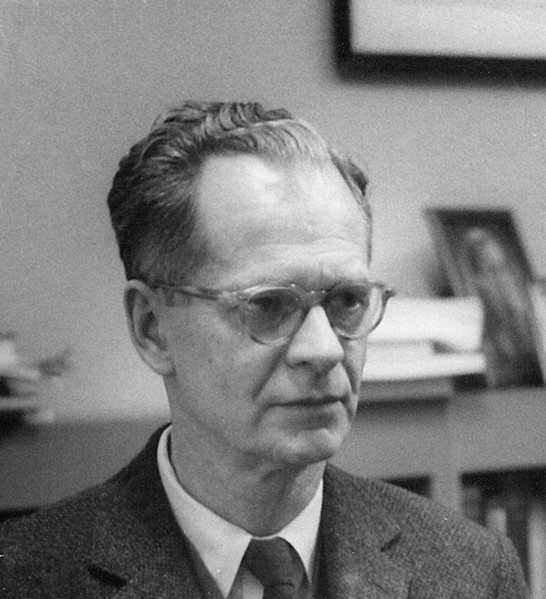
B. F. Skinner Berühmte Zitate
zitiert bei Peter Kenning: Consumer Neuroscience – ein transdisziplinäres Lehrbuch, Kohlhammer Verlag, Stuttgart 2014, ISBN 978-3-17-020727-1.
Zitate
B. F. Skinner: Was ist Behaviorismus? Reinbek, Rowohlt (1978). S. 18. Hier nach Peter Kenning: Consumer Neuroscience – ein transdisziplinäres Lehrbuch, Kohlhammer Verlag, Stuttgart 2014 PT36 books.google https://books.google.de/books?id=mlVtDAAAQBAJ&pg=PT36 <br class="br">Zitate
B. F. Skinner: Zitate auf Englisch
“Let men be happy, informed, skillful, well behaved, and productive.”
Freedom and the control of men (1955/1956) American Scholar, 25 (1), 47-65.
“Society attacks early, when the individual is helpless.”
B.F. Skinner Walden Two
Walden Two (1948), p. 95.
As quoted in "Unpacking the Skinner Box : Revisiting B. F. Skinner through a Postformal Lens" by Dana Salter in The Praeger Handbook of Education and Psychology Vol. 4 (2008) edited by Joe L. Kincheloe and Raymond A. Horn, Ch. 99, p. 872.
“We shouldn't teach great books; we should teach a love of reading.”
As quoted in B. F. Skinner : The Man and His Ideas (1968) by Richard Isadore Evans, p. 73.
Kontext: We shouldn't teach great books; we should teach a love of reading. Knowing the contents of a few works of literature is a trivial achievement. Being inclined to go on reading is a great achievement.
Contingencies of Reinforcement: A Theoretical Analysis (1969).
Quelle: Contingencies Of Reinforcement: A Theoretical Analysis
B.F. Skinner buch Beyond Freedom and Dignity
Quelle: Beyond Freedom and Dignity (1972).
"Free and Happy Student" in The Phi Delta Kappan (September 1973); later published in Reflections on Behaviorism and Society (1978).
Kontext: Many instructional arrangements seem "contrived", but there is nothing wrong with that. It is the teacher's function to contrive conditions under which students learn. Their relevance to a future usefulness need not be obvious.
It is a difficult assignment. The conditions the teacher arranges must be powerful enough to compete with those under which the student tends to behave in distracting ways.
“Education is what survives when what has been learned has been forgotten.”
"New methods and new aims in teaching", in New Scientist, 22(392) (21 May 1964), pp.483-4.
“I do not admire myself as a person. My successes do not override my shortcomings.”
Journal of Humanistic Psychology Spring 1991 vol. 31 no. 2 112-113
Science and Human Behavior (1953).
As quoted in Performance-based Assessment for Middle and High School Physical Education (2002) by Jacalyn Lea Lund and Mary Fortman Kirk, p. 165.
B.F. Skinner buch Beyond Freedom and Dignity
Beyond Freedom and Dignity (1972).
B.F. Skinner buch Beyond Freedom and Dignity
Beyond Freedom and Dignity, New York: Knopf, 1971 p. 155
“The way positive reinforcement is carried out is more important than the amount.”
As quoted in Meditations for Parents Who Do Too Much (1993) by Jonathon Lazear and Wendy Lazear, p. 5.
"Free and Happy Student" in The Phi Delta Kappan (September 1973); later published in Reflections on Behaviorism and Society (1978)
As quoted in B. F. Skinner : The Man and His Ideas (1968) by Richard Isadore Evans, p. 73
In operant conditioning we "strengthen" an operant in the sense of making a response more probable or, in actual fact, more frequent.
Science and Human Behavior (1953)


