S. I. Hayakawa buch Language in Thought and Action
Quelle: Language in Thought and Action (1949), Language as Symbolism, p. 27
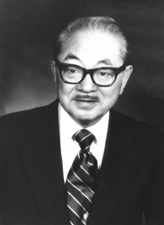
Samuel Ichiye Hayakawa war ein US-amerikanischer Psychologe, Semantiker und Politiker. Sein Werk Language in Thought and Action, sein wesentlicher Beitrag zur Einführung in die Semantik, gehört zu den Klassikern auf diesem Gebiet und wurde in zahlreiche Sprachen übersetzt
Hayakawa besuchte die Schulen seiner kanadischen Heimat in Calgary und Winnipeg. Seine ersten Abschlüsse machte er 1927 an der University of Manitoba in Winnipeg und 1928 an der McGill University in Montreal. Anschließend promovierte er 1935 zum Doctor of Philosophy an der University of Wisconsin in Madison. Dort begann danach auch im Jahr 1936 seine Laufbahn als Hochschullehrer. Er wechselte 1939 als Dozent an das Armour Institute of Technology in Chicago, wo er bis 1947 verblieb; danach übte er Lehrtätigkeiten an der University of Chicago und am San Francisco State College aus. In San Francisco fungierte er von 1968 bis 1973 auch als Präsident des damaligen College, aus dem 1974 die heutige State University wurde.
Von 1970 bis 1976 war Hayakawa als Kolumnist für ein Zeitungskonsortium tätig. Im Jahr 1976 trat er bei der Primary der Republikanischen Partei für die Wahlen zum US-Senat in Kalifornien an. In einem breiten Kandidatenfeld erzielte er einen Stimmenanteil von 38,3 Prozent und damit die relative Mehrheit gegenüber Konkurrenten wie dem ehemaligen Bundesminister Robert Finch, dem Kongressabgeordneten Alphonzo E. Bell und Exvizegouverneur John L. Harmer. Die eigentliche Wahl am 2. November 1976 gewann Hayakawa mit 50,2 Prozent der Stimmen gegen den demokratischen Amtsinhaber John V. Tunney. Daraufhin vertrat er den Bundesstaat Kalifornien vom 2. Januar 1977 bis zum 3. Januar 1983 im Kongress.
Für eine Wiederwahl stand Hayakawa im Jahr 1982 nicht zur Verfügung. Er setzte sich in Mill Valley zur Ruhe und starb im Februar 1992 in Greenbrae. Wikipedia
S. I. Hayakawa buch Language in Thought and Action
Quelle: Language in Thought and Action (1949), Language as Symbolism, p. 27
S. I. Hayakawa buch Language in Thought and Action
Footnote, p. 26
Language in Thought and Action (1949), The Symbolic Process
S. I. Hayakawa buch Language in Thought and Action
Quelle: Language in Thought and Action (1949), The Symbolic Process, pp. 24-25
S. I. Hayakawa buch Language in Thought and Action
Quelle: Language in Thought and Action (1949), The Symbolic Process, p. 24
S. I. Hayakawa buch Language in Thought and Action
Quelle: Language in Thought and Action (1949), Bearing the Unbearable, p. 144-145
S. I. Hayakawa buch Language in Thought and Action
Quelle: Language in Thought and Action (1949), Cooperation, p. 11
S. I. Hayakawa buch Language in Thought and Action
Quelle: Language in Thought and Action (1949), The Pooling of Knowledge, p. 14
S. I. Hayakawa buch Language in Thought and Action
Quelle: Language in Thought and Action (1949), What Animals Shall We Imitate?, p. 8
S. I. Hayakawa buch Language in Thought and Action
</SPAN>
Quelle: Language in Thought and Action (1949), Language as Symbolism, p. 27
S. I. Hayakawa buch Language in Thought and Action
See also: The Meaning of Meaning (1923)
See also: Science and Sanity (1933)
Quelle: Language in Thought and Action (1949), The Word Is Not the Thing, pp. 29-30
S. I. Hayakawa buch Language in Thought and Action
Quelle: Language in Thought and Action (1949), The Symbolic Process, p. 26
S. I. Hayakawa buch Language in Thought and Action
</SPAN>
Quelle: Language in Thought and Action (1949), The Niagara of Words, p. 18
S. I. Hayakawa buch Language in Thought and Action
Quelle: Language in Thought and Action (1949), Maps and Territories, p. 31
S. I. Hayakawa buch Language in Thought and Action
</SPAN>
Quelle: Language in Thought and Action (1949), Language as Symbolism, pp. 26-27
S. I. Hayakawa buch Language in Thought and Action
Language, that is to say, makes progress possible. </SPAN>
Quelle: Language in Thought and Action (1949), The Pooling of Knowledge, p. 12
S. I. Hayakawa buch Language in Thought and Action
Quelle: Language in Thought and Action (1949), The Pitfalls of Drama, pp. 27-28
S. I. Hayakawa buch Language in Thought and Action
Quelle: Language in Thought and Action (1949), The Niagara of Words, p. 16
S. I. Hayakawa buch Language in Thought and Action
Quelle: Language in Thought and Action (1949), The Niagara of Words, p. 17
S. I. Hayakawa buch Language in Thought and Action
Quelle: Language in Thought and Action (1949), The Niagara of Words, p. 15
S. I. Hayakawa buch Language in Thought and Action
Quelle: Language in Thought and Action (1949), The Symbolic Process, p. 26
S. I. Hayakawa buch Language in Thought and Action
Quelle: Language in Thought and Action (1949), The Pooling of Knowledge, p. 13
S. I. Hayakawa buch Language in Thought and Action
Quelle: Language in Thought and Action (1949), Maps and Territories, p. 32
S. I. Hayakawa buch Language in Thought and Action
Quelle: Language in Thought and Action (1949), The Pitfalls of Drama, p. 28
S. I. Hayakawa buch Language in Thought and Action
Quelle: Language in Thought and Action (1949), Giving Things Names, p. 209-210
S. I. Hayakawa buch Language in Thought and Action
Quelle: Language in Thought and Action (1949), The Pooling of Knowledge, p. 14
S. I. Hayakawa buch Language in Thought and Action
</SPAN>
Quelle: Language in Thought and Action (1949), The Pooling of Knowledge, pp. 14-15
S. I. Hayakawa buch Language in Thought and Action
To achieve this control, one may employ what Kenneth Burke has called "symbolic strategies" -- that is, ways of reclassifying our experiences so that they are "encompassed" and easier to bear. Whether by processes of "pouring out one's heart" or by "symbolic strategies" or by other means, we may employ symbolizations as mechanisms of relief when the pressures of a situation become intolerable. </SPAN>
Quelle: Language in Thought and Action (1949), Bearing the Unbearable, p. 144-145


