“When in doubt, use brute force.”
Quelle: http://wiki.c2.com/?BruteForce
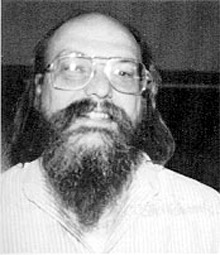
Kenneth „Ken“ Lane Thompson ist ein US-amerikanischer Informatiker, der unter anderem maßgeblich an der Entwicklung des Unix-Betriebssystems beteiligt war. Er erhielt für seine Arbeiten zahlreiche Ehrungen und Auszeichnungen, darunter den Turing Award. Wikipedia
“When in doubt, use brute force.”
Quelle: http://wiki.c2.com/?BruteForce
[The UNIX programming environment, Kernighan, Brian W., Brian Kernighan, Pike, Rob, w:Rob Pike, Prentice-Hall, 1984, 10269821, 0139376992], p. 204 http://books.google.com/books?id=poFQAAAAMAAJ&q=%22spell+creat+with+an+e%22&dq=%22spell+creat+with+an+e%22.
“The press, television, and movies make heroes of vandals by calling them whiz kids.”
"Reflections on Trusting Trust" http://cm.bell-labs.com/who/ken/trust.html, 1983 Turing Award Lecture http://cm.bell-labs.com/who/ken/trust.html,Communications of the ACM 27 (8), August 1984, pp. 761-763. <br class="br">Kontext: The press, television, and movies make heroes of vandals by calling them whiz kids.... There is obviously a cultural gap. The act of breaking into a computer system has to have the same social stigma as breaking into a neighbor's house. It should not matter that the neighbor's door is unlocked.
"Unix and Beyond: An Interview with Ken Thompson," 1999
Kontext: In Plan 9 and Inferno, the key ideas are the protocol for communicating between components and the simplification and extension of particular concepts. In Plan 9, the key abstraction is the file system—anything you can read and write and select by names in a hierarchy—and the protocol exports that abstraction to remote channels to enable distribution. Inferno works similarly, but it has a layer of language interaction above it through the Limbo language interface—which is like Java, but cleaner I think.
"Reflections on Trusting Trust" http://cm.bell-labs.com/who/ken/trust.html, 1983 Turing Award Lecture, Communications of the ACM 27 (8), August 1984, pp. 761-763. <br class="br">Kontext: You can't trust code that you did not totally create yourself. (Especially code from companies that employ people like me.) No amount of source-level verification or scrutiny will protect you from using untrusted code.
"Unix and Beyond: An Interview with Ken Thompson," 1999
Kontext: Unix was a very small, understandable OS, so people could change it at their will. It would run itself—you could type "go" and in a few minutes it would recompile itself. You had total control over the whole system. So it was very beneficial to a lot of people, especially at universities, because it was very hard to teach computing from an IBM end-user point of view. Unix was small, and you could go through it line by line and understand exactly how it worked. That was the origin of the so-called Unix culture.
“The X server has to be the biggest program I've ever seen that doesn't do anything for you.”
Thompson later followed up: "I now realize that X was just miles ahead in its programming style." http://www.google.com/moderator/#15/e=7f3&t=7f3.44 <br class="br">Plan 9 fortune file (1992)
Ken Thompson, talking about the origins of the Go programming language <br class="br"> Dr. Dobb's: Interview with Ken Thompson, 18 May 2011, 7 February 2014 http://www.drdobbs.com/open-source/interview-with-ken-thompson/229502480, <br class="br">"Interview with Ken Thompson", 2011
“It does everything Unix does only less reliably.”
In response to the question, "Can you sum up plan 9 in layman's terms?"
Plan 9 fortune file (1992)
“grep was a private command of mine for quite a while before i made it public.”
Quelle: The history of grep, the 40 years old Unix command, Benjamin Rualthanzauva, 5 Feb 2014 https://medium.com/@rualthanzauva/grep-was-a-private-command-of-mine-for-quite-a-while-before-i-made-it-public-ken-thompson-a40e24a5ef48,
Ken Thompson; cited in
"Coders At Work", 2009
“Hi, this is Ken. What's the root password?”
Plan 9 fortune file (1992)
"Unix and Beyond: An Interview with Ken Thompson," 1999
"Unix and Beyond: An Interview with Ken Thompson," 1999
Ken Thompson; cited in [Seibel, Peter, Coders At Work, 2009, 475]
"Coders At Work", 2009
“We have persistent objects, they're called files.”
Plan 9 fortune file (1992)
“There's going to be no serious problem after this.”
Plan 9 fortune file (1992)
"Unix and Beyond: An Interview with Ken Thompson," 1999
I feel the same about Unix.
"Ken Thompson clarifies matters", 1999
"Unix and Beyond: An Interview with Ken Thompson," 1999
“I think the open software movement (and Linux in particular) is laudable.”
"Ken Thompson clarifies matters", 1999
Ken Thompson; cited in [Seibel, Peter, Coders At Work, 2009, 479]
"Coders At Work", 2009
“If you want to go somewhere, goto is the best way to get there.”
Plan 9 fortune file (1992)
Thompson on the superiority of <tt>ed</tt> to editors such as today's <tt>vi</tt> or <tt>emacs</tt>, as summarized by Peter Salus in A Quarter Century of UNIX (Addison-Wesley, 1994). http://web.archive.org/web/20080103071208/http://www.dcs.qmul.ac.uk/~george/history/
“Gigabit' seems to mean 600 megabits. It's a VAX gigabit.”
Plan 9 fortune file (1992)
"Reflections on Trusting Trust" http://delivery.acm.org/10.1145/360000/358210/reflections.pdf, 1983 Turing Award Lecture, Communications of the ACM 27 (8), August 1984, pp. 761-763.
"Reflections on Trusting Trust" http://delivery.acm.org/10.1145/360000/358210/reflections.pdf, 1983 Turing Award Lecture, Communications of the ACM 27 (8), August 1984, pp. 761-763.


