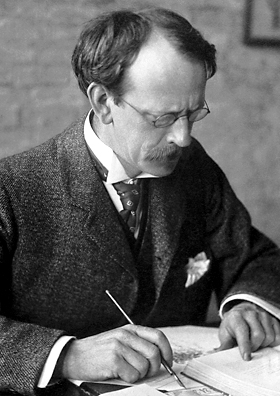
Joseph John Thomson Zitate

Sir Joseph John Thomson OM war ein britischer Physiker und Nobelpreisträger für Physik. Er entdeckte 1897 – etwa zeitgleich mit dem deutschen Physiker Emil Wiechert – das Elektron. Wikipedia  

✵ 18. Dezember 1856 – 30. August 1940
Joseph John Thomson Foto
Joseph John Thomson: 8 Zitate0 Gefällt mir

Joseph John Thomson: Zitate auf Englisch

“The difficulties which would have to be overcome to make several of the preceding experiments conclusive are so great as to be almost insurmountable.”

J. J. Thomson

Warning about the non-conclusiveness for the experimental foundation of electrostatic theory, in a footnote of the third edition of: [James Clerk Maxwell, A Treatise on Electricity and Magnetism, Vol.1, 3rd Edition, Oxford University Press, 1891, 37]
Quotes eat me

“The electron: may it never be of any use to anybody!”

J. J. Thomson

A popular toast or slogan at J. J. Thomson's Cavendish Laboratory in the first years of the 1900s, as quoted in Proceedings of the Royal Institution of Great Britain, Volume 35 (1951), p. 251.
Attributed

“I can see no escape from the conclusion that they are charges of negative electricity carried by particles of matter.”

J. J. Thomson

&quot;Cathode rays&quot; http://web.lemoyne.edu/~GIUNTA/thomson1897.html Philosophical Magazine, 44, 293 (1897). <br class="br">Quotes eat me <br class="br">Kontext: As the cathode rays carry a charge of negative electricity, are deflected by an electrostatic force as if they were negatively electrified, and are acted on by a magnetic force in just the way in which this force would act on a negatively electrified body moving along the path of these rays, I can see no escape from the conclusion that they are charges of negative electricity carried by particles of matter.

“We see from Lenard's table that a cathode ray can travel through air at atmospheric pressure a distance of about half a centimetre before the brightness of the phosphorescence falls to about half its original value. Now the mean free path of the molecules of air at this pressure is about 10-5 cm., and if a molecule of air were projected it would lose half its momentum in a space comparable with the mean free path. Even if we suppose that it is not the same molecule that is carried, the effect of the obliquity of the collisions would reduce the momentum to half in a short multiple of that path. Thus, from Lenard's experiments on the absorption of the rays outside the tube, it follows on the hypothesis that the cathode rays are charged particles moving with high velocities, that the size of the carriers must be small compared with the dimensions of ordinary atoms or molecules. The assumption of a state of matter more finely subdivided than the atom of an element is a somewhat startling one; but a hypothesis that would involve somewhat similar consequences—viz. that the so-called elements are compounds of some primordial element—has been put forward from time to time by various chemists.”

J. J. Thomson

Royal Institution Lecture (April 30, 1897) as quoted by Edmund Taylor Whittaker, A History of the Theories of Aether and Electricity from the Age of Descartes to the Close of the Nineteenth Century http://books.google.com/books?id=CGJDAAAAIAAJ (1910). <br class="br">Quotes eat me

Ähnliche Autoren

Max Born Foto
Max Born3
deutscher Mathematiker und Physiker, Nobelpreisträger für P… None
Wilhelm Wien Foto
Wilhelm Wien1
deutscher Physiker; Nobelpreisträger für Physik (1911) None
Isidor Isaac Rabi Foto
Isidor Isaac Rabi1
US-amerikanischer Physiker None
Erwin Schrödinger Foto
Erwin Schrödinger8
österreichischer Physiker und Wissenschaftstheoretiker None
Max Planck Foto
Max Planck13
deutscher Physiker None
Niels Bohr Foto
Niels Bohr6
dänischer Physiker des 20. Jahrhunderts None
Nikola Tesla Foto
Nikola Tesla46
Erfinder und Physiker None
Werner Heisenberg Foto
Werner Heisenberg10
deutscher Physiker und Nobelpreisträger None
Stephen Hawking Foto
Stephen Hawking97
britischer theoretischer Physiker None
Wolfgang Pauli Foto
Wolfgang Pauli5
österreichischer Physiker und Nobelpreisträger None