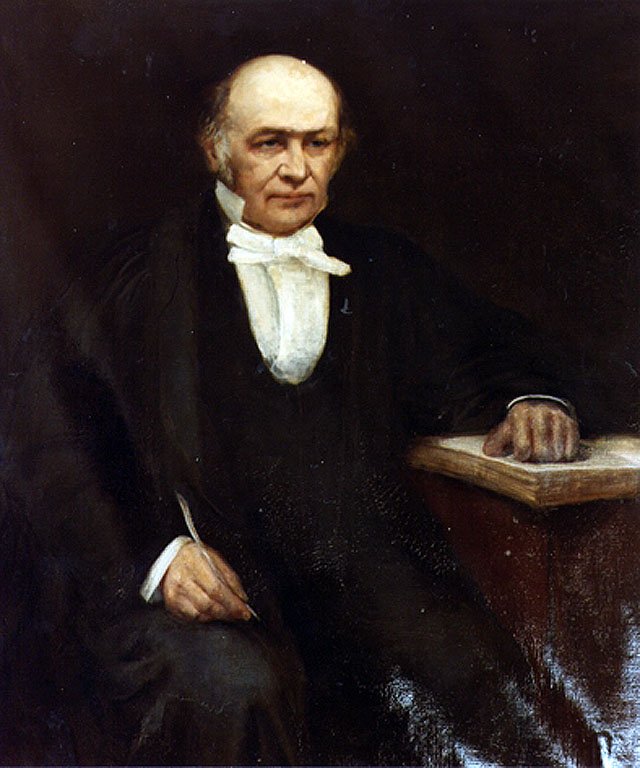
“I was led, many years ago, to regard Algebra as the Science of Pure Time”
Preface, Lectures on Quaternions: Containing a Systematic Statement of a New Mathematical Method of which the Principles were Communicated in 1843 to the Royal Irish Academy... (1853) pp. 1-4 https://books.google.com/books?id=PJIKAAAAYAAJ&pg=PA1. Hamilton makes reference to the article "Theory of Conjugate Functions, or Algebraic Couples; with a Preliminary and Elementary Essay on Algebra as the Science of Pure Time" (Read November 4th, 1833, and June 1st, 1835) Transactions of the Royal Irish Academy Vol. XVII, Part II (Dublin, 1835) pp 293-422. <br class="br">Kontext: The difficulties which so many have felt in the doctrine of Negative and Imaginary Quantities in Algebra forced themselves long ago on my attention... And while agreeing with those who had contended that negatives and imaginaries were not properly quantities at all, I still felt dissatisfied with any view which should not give to them, from the outset, a clear interpretation and meaning... It early appeared to me that these ends might be attained by our consenting to regard Algebra as being no mere Art, nor Language, nor primarily a Science of Quantity; but rather as the Science of Order in Progression. It was, however, a part of this conception, that the progression here spoken of was understood to be continuous and unidimensional: extending indefinitely forward and backward, but not in any lateral direction. And although the successive states of such a progression might (no doubt) be represented by points upon a line, yet I thought that their simple successiveness was better conceived by comparing them with moments of time, divested, however, of all reference to cause and effect; so that the "time" here considered might be said to be abstract, ideal, or pure, like that "space" which is the object of geometry. In this manner I was led, many years ago, to regard Algebra as the Science of Pure Time: and an Essay, containing my views respecting it as such, was published in 1835.... [I]f the letters A and B were employed as dates, to denote any two moments of time, which might or might not be distinct, the case of the coincidence or identity of these two moments, or of equivalence of these two dates, was denoted by the equation,B = Awhich symbolic assertion was thus interpreted as not involving any original reference to quantity, nor as expressing the result of any comparison between two durations as measured. It corresponded to the conception of simultaneity or synchronism; or, in simpler words, it represented the thought of the present in time. Of all possible answers to the general question, "When," the simplest is the answer, "Now:" and it was the attitude of mind, assumed in the making of this answer, which (in the system here described) might be said to be originally symbolized by the equation above written.


