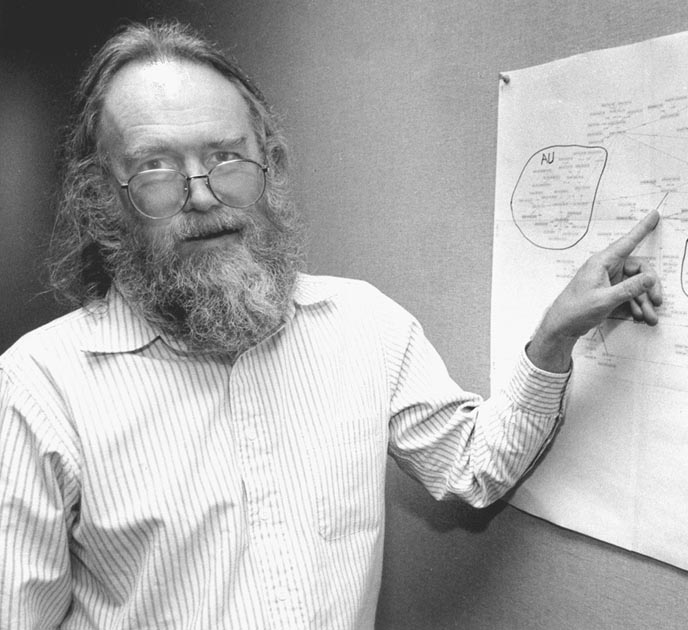
When asked "What do you think of being called a god?" in "Heavenly Father of the NET", an interview article in NetWorker (Summer 1997); This refers to a statement "if the Net does have a god, he is probably Jon Postel", which appeared in the British magazine The Economist.
Kontext: I think they called me the closest thing to a God of the Internet. But at the end, that article wasn’t very complimentary, because the author suggested that I wasn’t doing a very good job, and that I ought to be replaced by a "professional."
Of course, there isn’t any "God of the Internet." The Internet works because a lot of people cooperate to do things together.
Jon Postel: 7 Zitate0 Gefällt mir
Jon Postel: Zitate auf Englisch
Jon Postel RFC 793: Transmission Control Protocol
The "Robustness Principle", RFC 793 http://www.ietf.org/rfc/rfc0793.txt, Transmission Control Protocol, entire text of section 2.10 (September 1981).
RFC 791 http://www.ietf.org/rfc/rfc0791.txt, Internet Protocol (September 1981) <br class="br">Often shortened to Be liberal in what you accept, and conservative in what you send.
RFC (Request for Comments) document: RFC 791 http://www.ietf.org/rfc/rfc0791.txt, Internet Protocol (September 1981) <br class="br">This is often mistakenly attributed to Jon Postel, but it is actually a very slight variation on a quotation from John Shoch; both RFC-791 and its earlier version RFC-760 include, at the point in the text where this passage appears, a reference to Shoch's paper Inter-Network Naming, Addressing, and Routing, which is the original source of this observation. <br class="br">Misattributed
Where Wizards Stay Up Late (1996) by Katie Hafner and Matthew Lyon
Of course, there isn’t any "God of the Internet." The Internet works because a lot of people cooperate to do things together.
When asked "What do you think of being called a god?" in "Heavenly Father of the NET", an interview article in NetWorker (Summer 1997); This refers to a statement "if the Net does have a god, he is probably Jon Postel", which appeared in the British magazine The Economist.
The Economist (1997-02-08).


