“tt>echo 'Congratulations. You aren't running Eunice.
Source code, <code>Configure</code>
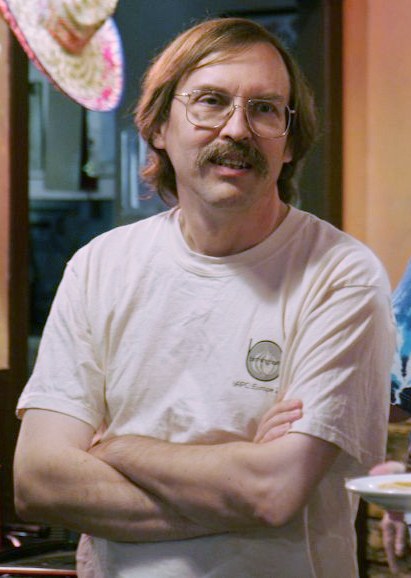
Larry Wall ist ein US-amerikanischer Linguist, Programmierer und Autor.
Wall studierte an der Seattle Pacific University Linguistik und als graduate student an der University of California, Los Angeles und der University of California, Berkeley. Nach seinen Studien war er vor allem als Systemadministrator und Programmierer tätig, später auch als Buchautor. Wall arbeitete unter anderem für das Jet Propulsion Laboratory, für Unisys und für den O’Reilly Verlag.
Er ist Erfinder der Programmiersprache Perl, des weitverbreiteten Programms patch, Autor des Usenet-Clients rn und des Erzeugers von Konfigurationsscripten metaconfig. Er gewann zweimal den IOCCC-Wettbewerb für den undurchsichtigsten C-Quelltext, erhielt im März 1993 den Dr. Dobbs Journal Excellence in Programming Award und im Oktober 1998 den ersten FSF Award. Das von ihm mitgeschriebene Kamelbuch war eines der ersten Bücher über Perl und gilt heute noch als Grundlage zum Studium der Sprache. Seit Jahren ist er vor allem mit der Neugestaltung der Perl-6-Syntax beschäftigt.
Wall ist, abgesehen von seinen Fähigkeiten als Programmierer, bekannt für seinen Humor, seinen Sprachwitz und seinen feinen Sinn für Ironie, der oft in Diskussionen im Usenet oder auf Mailinglisten, in Interviews und in Reden auf Open-Source-Kongressen zum Vorschein kommt.
Er ist verheiratet mit Gloria Wall, mit der er vier Kinder hat, darunter den Physiker Aron C. Wall. Außerdem bekennt er sich gern öffentlich zu seinem christlichen Glauben. Er gehört der Cupertino New Life Nazarene Church an und spielt leidenschaftlich gern Geige. Wikipedia
“tt>echo 'Congratulations. You aren't running Eunice.
Source code, <code>Configure</code>
“There's really no way to fix this and still keep Perl pathologically eclectic.”
Larry Wall buch Programming Perl
Larry Wall, Tom Christiansen, and Jon Orwant, Programming Perl, third edition, section 3.10.
Other
Public Talks, "Present Continuous - Future Perfect"
[199710281816.KAA29614@wall.org, 1997]
Usenet postings, 1997
“Perhaps I'm missing the gene for making enemies.”
[199708040319.UAA16213@wall.org, 1997]
Usenet postings, 1997
“(Never thought I'd be telling Malcolm and Ilya the same thing…”
[199711071819.KAA29909@wall.org, 1997]
Usenet postings, 1997
[7886@jpl-devvax.JPL.NASA.GOV, 1990]
Usenet postings, 1990
“tt>s = (char*)(long)retval; /* ouch */
doio.c.
Source code, Other files
[199709081854.LAA20830@wall.org, 1997]
Usenet postings, 1997
“The autodecrement is not magical.”
In the perl man page.
Documentation
“… an initial underscore already conveys strong feelings of magicalness to a C programmer.”
[1992Nov9.195250.23584@netlabs.com, 1992]
Usenet postings, 1992
“It's certainly easy to calculate the average attendance for Perl conferences.”
[199710071721.KAA19014@wall.org, 1997]
Usenet postings, 1997
Working on Perl, of course. [199807211548.IAA26184@wall.org, 1998]
Usenet postings, 1998
“As with all the other proposals, it's basically just a list of words. You can deal with that…”
[199709032332.QAA21669@wall.org, 1997]
Usenet postings, 1997
“I suppose one could claim that an undocumented feature has no semantics. :-(”
[199710290036.QAA01818@wall.org, 1997]
Usenet postings, 1997
“If you want your program to be readable, consider supplying the argument.”
In the perl man page.
Documentation
“In general, they do what you want, unless you want consistency.”
In the perl man page.
Documentation
“I surely do hope that's a syntax error.”
[199710011752.KAA21624@wall.org, 1997]
Usenet postings, 1997
[1994Apr6.184419.3687@netlabs.com, 1994]
Usenet postings, 1994
[20031217195433.GB31020@wall.org, 2003]
Usenet postings, 2003
“tt>signal(i, SIG_DFL); /* crunch, crunch, crunch */
doarg.c.
Source code, Other files
[199705102042.NAA00851@wall.org, 1997]
Usenet postings, 1997
“I don't like this official/unofficial distinction. It sound, er, officious.”
[199702221943.LAA20388@wall.org, 1997]
Usenet postings, 1997
“tt>echo 'Your stdio isn't very std.'
Source code, <code>Configure</code>
“Portability should be the default.”
[199711072201.OAA01123@wall.org, 1997]
Usenet postings, 1997
“It's hard to tune heavily tuned code.”
[199801141725.JAA07555@wall.org, 1998]
Usenet postings, 1998


