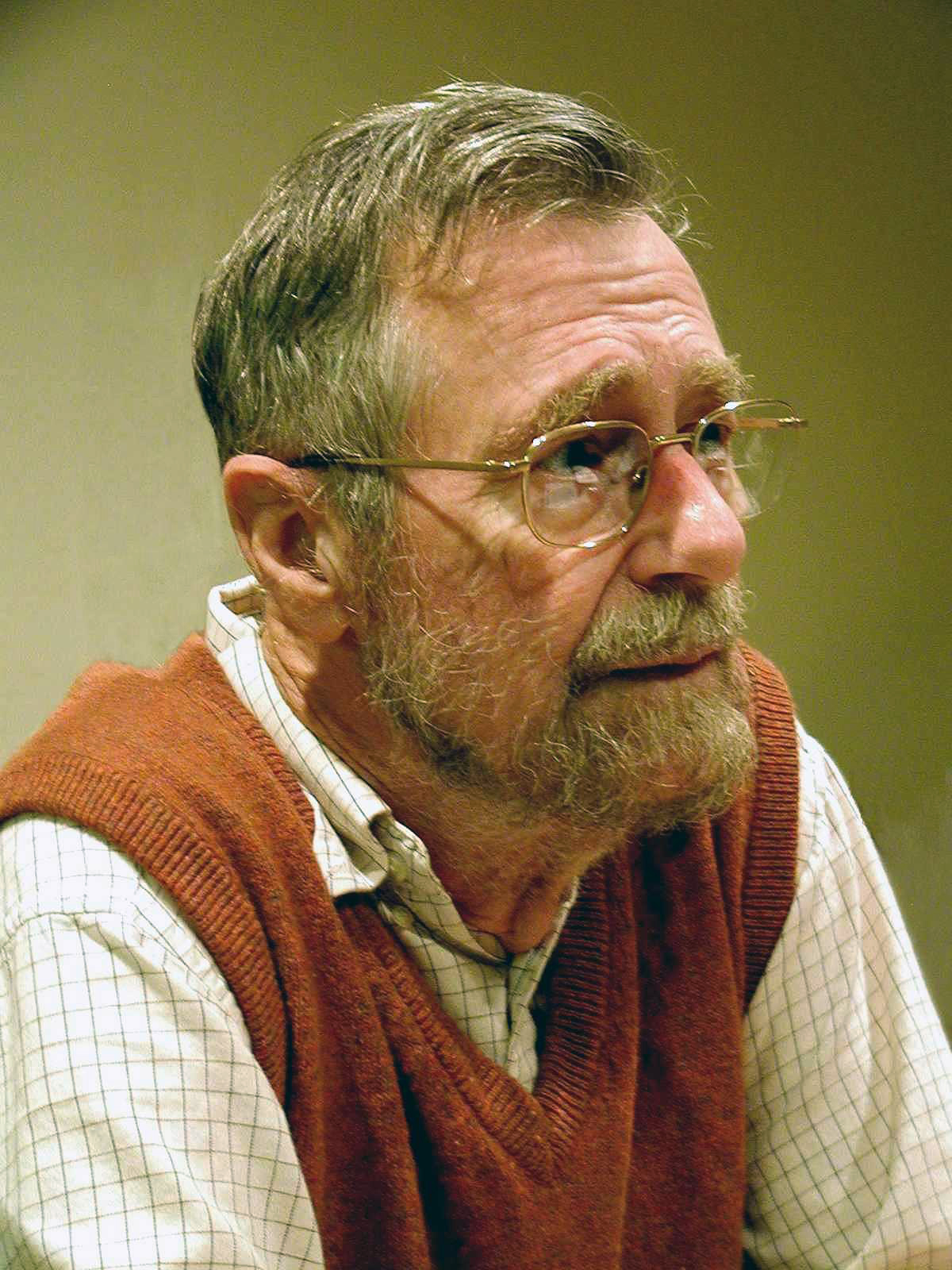
Edsger Wybe Dijkstra Zitate
seite 2

Edsger Wybe Dijkstra war ein niederländischer Informatiker. Er war der Wegbereiter der strukturierten Programmierung. 1972 erhielt er den Turing Award für grundlegende Beiträge zur Entwicklung von Programmiersprachen. Wikipedia  

✵ 11. Mai 1930 – 6. August 2002
Edsger Wybe Dijkstra Foto
Edsger Wybe Dijkstra: 74 Zitate5 Gefällt mir

Edsger Wybe Dijkstra Berühmte Zitate

„Durch Testen kann man stets nur die Anwesenheit, nie aber die Abwesenheit von Fehlern beweisen.“

Edsger Wybe Dijkstra

Original: (en) Program testing can be a very effective way to show the presence of bugs, but is hopelessly inadequate for showing their absence.
Quelle: The Humble Programmer, ACM Turing Lecture 1972

„Als es noch keine Computer gab, gab es auch das Programmieren als Problem nicht. Als es dann ein paar leistungsschwache Computer gab, wurde das Programmieren zu einem kleinen Problem und nun, wo wir leistungsstarke Computer haben, ist auch das Programmieren zu einem riesigen Problem angewachsen. In diesem Sinne hat die elektronische Industrie kein einziges Problem gelöst, sondern nur neue geschaffen.“

Edsger Wybe Dijkstra

Original: (en) As long as there were no machines, programming was no problem at all; when we had a few weak computers, programming became a mild problem, and now we have gigantic computers, programming had become an equally gigantic problem. In this sense the electronic industry has not solved a single problem, it has only created them
Quelle: The Humble Programmer, ACM Turing Lecture 1972

„Abgesehen von einer mathematischen Neigung ist eine außergewöhnlich gute Beherrschung seiner Muttersprache die unentbehrlichste Qualität eines fähigen Programmierers.“

Edsger Wybe Dijkstra

Original: (en) Besides a mathematical inclination, an exceptionally good mastery of one's native tongue is the most vital asset of a competent programmer.
Quelle: How do we tell truths that might hurt?, 1975

„Es ist praktisch unmöglich, einem Studenten gutes Programmieren beizubringen, wenn er vorher in BASIC programmiert hat. Als potenzielle Programmierer sind sie geistig verstümmelt ohne Hoffnung auf Erholung.“

Edsger Wybe Dijkstra

Original: (en) It is practically impossible to teach good programming to students that have had a prior exposure to BASIC: As potential programmers they are mentally mutilated beyond hope of regeneration.
Quelle: How do we tell truths that might hurt? 18. Juni 1975

„Wenn du effektivere Programmierer möchtest, wirst du bemerken, dass sie keine Zeit mit debuggen verschwenden sollten, statt dessen sollten sie von vorne herein keine Bugs einführen.“

Edsger Wybe Dijkstra

Original: (en) If you want more effective programmers, you will discover that they should not waste their time debugging, they should not introduce the bugs to start with.
Quelle: The Humble Programmer, 1972

„LISP wurde scherzhaft beschrieben als die wohl 'intelligenteste Art einen Computer zu missbrauchen'. Ich halte diese Beschreibung für ein großes Kompliment, vermittelt sie doch ganz und gar den Eindruck von Befreiung: Es half einigen unserer begabtesten Mitmenschen dabei, bis dahin Unmögliches zu denken.“

Edsger Wybe Dijkstra

The Humble Programmer, 1972
Original: (en) LISP has been jokingly described as "the most intelligent way to misuse a computer". I think that description a great compliment because it transmits the full flavor of liberation: it has assisted a number of our most gifted fellow humans in thinking previously impossible thoughts

Edsger Wybe Dijkstra: Zitate auf Englisch

“Testing shows the presence, not the absence of bugs”

Edsger W. Dijkstra

Dijkstra (1969) J.N. Buxton and B. Randell, eds, Software Engineering Techniques, April 1970, p. 16. Report on a conference sponsored by the NATO Science Committee, Rome, Italy, 27–31 October 1969. http://homepages.cs.ncl.ac.uk/brian.randell/NATO/nato1969.PDF Possibly the earliest documented use of the famous quote. <br class="br">1960s

“My point today is that, if we wish to count lines of code, we should not regard them as "lines produced" but as "lines spent": the current conventional wisdom is so foolish as to book that count on the wrong side of the ledger.”

Edsger W. Dijkstra

Dijkstra (1988) &quot; On the cruelty of really teaching computing science http://www.cs.utexas.edu/users/EWD/transcriptions/EWD10xx/EWD1036.html (EWD1036). <br class="br">1980s

“Write a paper promising salvation, make it a 'structured' something or a 'virtual' something, or 'abstract', 'distributed' or 'higher-order' or 'applicative' and you can almost be certain of having started a new cult.”

Edsger W. Dijkstra

Dijkstra (1979) My hopes of computing science http://www.cs.utexas.edu/users/EWD/transcriptions/EWD07xx/EWD709.html (EWD 709). <br class="br">1970s

“Several people have told me that my inability to suffer fools gladly is one of my main weaknesses.”

Edsger W. Dijkstra

Dijkstra (1978) The pragmatic engineer versus the scientific designer http://www.cs.utexas.edu/users/EWD/transcriptions/EWD06xx/EWD690.html (EWD 690). <br class="br">1970s

“The art of programming is the art of organizing complexity, of mastering multitude and avoiding its bastard chaos as effectively as possible.”

Edsger W. Dijkstra

Dijkstra (1970) &quot; Notes On Structured Programming http://www.cs.utexas.edu/users/EWD/ewd02xx/EWD249.PDF&quot; (EWD249), Section 3 (&quot;On The Reliability of Mechanisms&quot;), p. 7. <br class="br">1970s

“The problems of the real world are primarily those you are left with when you refuse to apply their effective solutions.”

Edsger W. Dijkstra

Dijkstra (1988) &quot; On the cruelty of really teaching computing science http://www.cs.utexas.edu/users/EWD/transcriptions/EWD10xx/EWD1036.html (EWD1036). <br class="br">1980s

“On Our Inability To Do Much.”

Edsger W. Dijkstra

Dijkstra (1972) "Structured Programming", Chapter title in O.J. Dahl, E.W. Dijkstra, and C.A.R. Hoare. Academic Press, 1972 ISBN 0122005503.
1970s

“When we had no computers, we had no programming problem either. When we had a few computers, we had a mild programming problem. Confronted with machines a million times as powerful, we are faced with a gigantic programming problem.”

Edsger W. Dijkstra

Dijkstra (1986) Visuals for BP&#x27;s Venture Research Conference http://www.cs.utexas.edu/users/EWD/transcriptions/EWD09xx/EWD963.html (EWD 963). <br class="br">1980s

Ähnliche Autoren

Etty Hillesum Foto
Etty Hillesum6
niederländisch-jüdische Lehrerin None
Audrey Hepburn Foto
Audrey Hepburn2
britische Schauspielerin None
Richard Dawkins Foto
Richard Dawkins22
Britischer Zoologe, Biologe und Autor None
Noam Chomsky Foto
Noam Chomsky39
Professor für Linguistik am Massachusetts Institute of Tech… None
Joseph Weizenbaum Foto
Joseph Weizenbaum7
deutsch-amerikanischer Informatiker und Computerkritiker None
Leon de Winter Foto
Leon de Winter3
niederländischer Schriftsteller und Filmemacher None
Harry Mulisch Foto
Harry Mulisch8
niederländischer Schriftsteller None
Adele Sandrock Foto
Adele Sandrock1
deutsch-niederländische Schauspielerin None
Donald Ervin Knuth Foto
Donald Ervin Knuth4
amerikanischer Informatiker, emeritierter Professor für Inf… None
 Joep Lange Foto
Joep Lange1
niederländischer HIV-Forscher None