[10, 1–2, January 1984, 1–35, Physica D: Nonlinear Phenomena, Universality and complexity in cellular automata, 10.1016/0167-2789(84)90245-8]
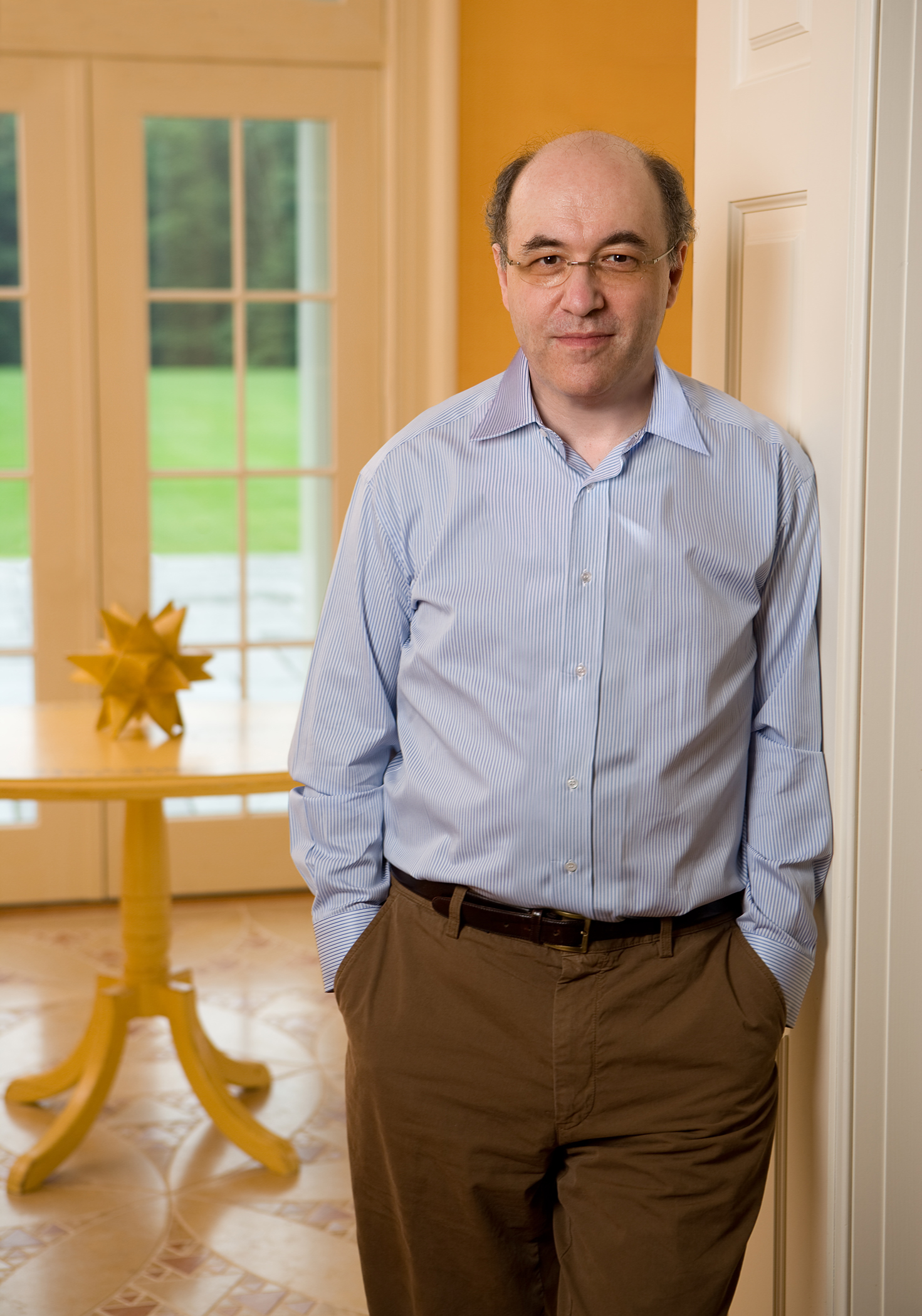
Stephen Wolfram: 16 Zitate0 Gefällt mir
Stephen Wolfram: Zitate auf Englisch
“Problem 9. What is the correspondence between cellular automata and continuous systems?”
(originally published in 1985 in Physica Scripta T9: 170–183)
Kontext: Problem 9. What is the correspondence between cellular automata and continuous systems?
Cellular automatat are discrete in several respects. First, they consist of a discrete spatial lattice of sites. Second, they evolve in discrete steps. And finally, each site has only a finite discrete set of possible values.
The first two forms of discreteness are addressed in the numerical analysis of approximate solutions to, say, differential equations....
The third form of discreteness in cellular automata is not so familiar from numerical analysis. It is an extreme form of round-off, in which each "number" can have only a few possible values (rather than the usual 216 or 232).
"Computing a Theory of Everything" (2010)
"Computing a Theory of Everything" (2010)
“I think Computation is destined to be the defining idea of our future.”
"Computing a Theory of Everything" (2010)
"Computing a Theory of Everything" (2010)
[Undecidability and intractability in theoretical physics, Physical Review Letters, 54, 8, 1985, 735–738, 10.1103/PhysRevLett.54.735, https://www.stephenwolfram.com/publications/academic/undecidability-intractability-theoretical-physics.pdf]
“Stephen has gone out on a limb. He is proposing a paradigm shift. A new twist on everything.”
Gregory Chaitin as quoted by Edward Rothstein in [A Man Who Would Shake Up Science; Physicist Says He's Explained The Way Nature Operates, 11 May 2002, The New York Times, http://www.nytimes.com/2002/05/11/books/man-who-would-shake-up-science-physicist-says-he-s-explained-way-nature-operates.html]
Freeman Dyson cited in: " Living a Paradigm Shift: Looking Back on Reactions to A New Kind of Science http://blog.stephenwolfram.com/2012/05/living-a-paradigm-shift-looking-back-on-reactions-to-a-new-kind-of-science/," blog.stephenwolfram.com May 11, 2012
...One of the scenarios for the very long term history ...is the heat death of the universe where everything... becomes thermodynamically boring... equilibrium. People say that's a really bad outcome, but actually... it's an outcome where there's all this computation going on... molecules bouncing around in very complicated ways, doing this very elaborate computation. It just happens to be a computation that right now, we haven't found ways to understand... [O]ur brains... and our mathematics and our science... haven't found ways to tell an interesting story about that. It just looks boring to us.
Stephen Wolfram: Fundamental Theory of Physics, Life, and the Universe (Sep 15, 2020)
Stephen Wolfram: Fundamental Theory of Physics, Life, and the Universe (Sep 15, 2020)
Stephen Wolfram: Fundamental Theory of Physics, Life, and the Universe (Sep 15, 2020)
Stephen Wolfram: Fundamental Theory of Physics, Life, and the Universe (Sep 15, 2020)
Stephen Wolfram: Fundamental Theory of Physics, Life, and the Universe (Sep 15, 2020)
Stephen Wolfram: Fundamental Theory of Physics, Life, and the Universe (Sep 15, 2020)


