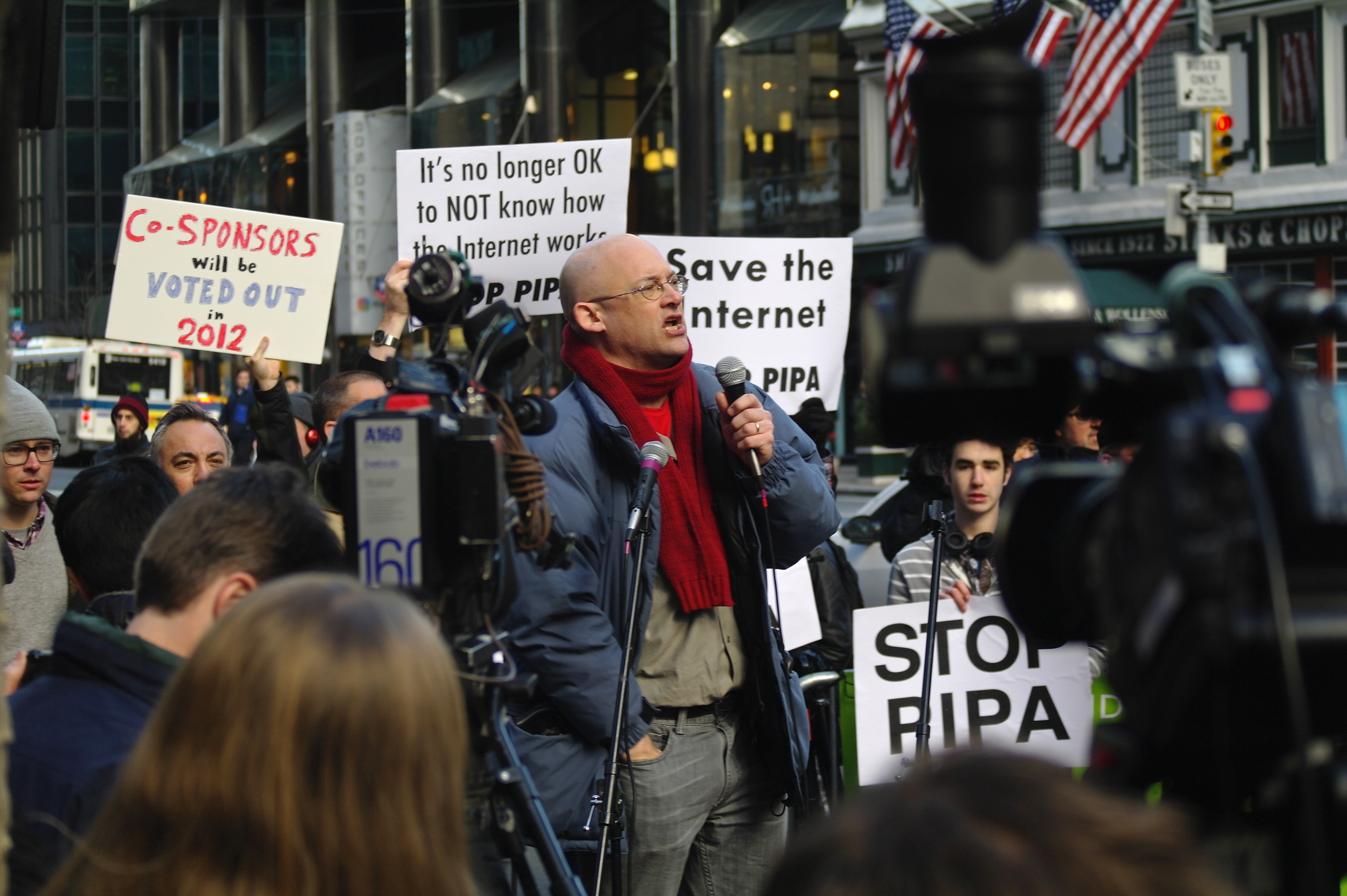
Clay Shirky Zitate

Clay Shirky ist ein US-amerikanischer Redner, Autor und Berater zum Thema Internet. Er unterrichtet Neue Medien als Assistenzprofessor im Rahmen des Interactive Telecommunications Program an der New York University. Sein Unterricht umfasst unter anderem die Effekte der Netzwerktopologien von sozialen Netzwerken und die Frage, wie das Internet menschliche Beziehungen, Kommunikation und Gesellschaft verändert.

Shirkys Kolumnen und Artikel wurden unter anderem in Business 2.0, der New York Times, dem Wall Street Journal, dem Harvard Business Review und dem Wired-Magazin veröffentlicht. Am 3. April 2008 trat Shirky im Colbert Report auf.

In seiner Beratungstätigkeit fokussiert sich Shirky auf die steigende Bedeutung dezentraler Technologien wie Peer-to-Peer, Webservices und Funknetze, die Alternativen zur Client-Server-Infrastruktur darstellen, die das World Wide Web charakterisiert. Zu seinen Kunden zählen Nokia, die Library of Congress und die BBC. Wikipedia  

✵ 1964
Clay Shirky Foto
Clay Shirky: 19 Zitate0 Gefällt mir

Clay Shirky: Zitate auf Englisch

“When we change the way we communicate, we change society.”

Clay Shirky

Shirky (2008), cited in: Jennex, Murray (2012). Managing Crises and Disasters with Emerging Technologies. p. 3

“Gutenberg’s press flooded the market. In the early 1500s John Tetzel, the head pardoner for German territories, would sweep into a town with a collection of already printed indulgences, hawking them with a phrase usually translated as “When a coin a coffer rings / A soul for heaven springs.” The nakedly commercial aspects of indulgences, among other things, enraged Martin Luther, who in 1517 launched an attack on the Church in the form of his famous Ninety-five Theses. He first nailed the theses to a church door in Wittenberg, but copies were soon printed up and disseminated widely. Luther’s critique, along with the spread of Bibles translated into local languages, drove the Protestant Reformation, plunging the Church (and Europe) into crisis. The tool that looked like it would strengthen the social structure of the age instead upended it. From the vantage point of 1450, the new technology seemed to do nothing more than offer the existing society a faster and cheaper way to do what it was already doing. By 1550 it had become apparent that the volume of indulgences had debauched their value, creating “indulgence inflation”—further evidence that abundance can be harder for a society to deal with than scarcity. Similarly, the spread of Bibles wasn’t a case of more of the same, but rather of more is different—the number of Bibles produced increased the range of Bibles produced, with cheap Bibles translated into local languages undermining the interpretative monopoly of the clergy, since churchgoers could now hear what the Bible said in their own language, and literate citizens could read it for themselves, with no priest anywhere near. By the middle of the century, Luther’s Protestant Reformation had taken hold, and the Church’s role as the pan-European economic, cultural, intellectual, and religious force was ending.”

Clay Shirky

Cognitive Surplus : Creativity and Generosity in a Connected Age (2010)

Ähnliche Autoren

Christopher Paolini Foto
Christopher Paolini9
US-amerikanischer Autor None
Dan Brown Foto
Dan Brown2
US-amerikanischer Schriftsteller None
Chuck Palahniuk Foto
Chuck Palahniuk56
US-amerikanischer Autor None
Nicholas Sparks Foto
Nicholas Sparks28
US-amerikanischer Schriftsteller None
Patrick Rothfuss Foto
Patrick Rothfuss12
US-amerikanischer Fantasy-Schriftsteller None
Paul Walker Foto
Paul Walker1
US-amerikanischer Schauspieler None
 P. C. Cast Foto
P. C. Cast3
US-amerikanische Autorin None
Miley Cyrus Foto
Miley Cyrus15
US-amerikanische Schauspielerin und Sängerin None
Marilyn Manson Foto
Marilyn Manson34
US-amerikanischer Musiker und Mitglied der Rockband Marilyn… None
Lady Gaga Foto
Lady Gaga4
US-amerikanische Sängerin und Songwriterin. None